%20no%20one%20tells%20you?unique=a09623b)
Of all the cosmetic ingredients, hyaluronic acid seems the most unsuspecting. It's naturally present in our skin from birth, it's biodegradable, and it's also produced by our bodies every day. For years, it's been touted as a universally safe ingredient, suitable for all skin types, even the most reactive.
Yet scientific research in recent years has highlighted a paradox that almost no brand communicates to their customers: certain fractions of hyaluronic acid - precisely the smallest ones, those that penetrate deepest - can activate the same biological mechanisms that the skin uses to signal tissue damage. Simply put: they can mimic an inflammation signal.
How is this possible? The answer lies in two words: molecular weight.
What is hyaluronic acid
Hyaluronic acid (HA) is a linear glycosaminoglycan naturally present in the extracellular matrix of the skin. Its main functions are threefold: maintaining tissue hydration, supporting healing, and modulating the inflammatory response. It is not a "foreign" ingredient in the body - it is an integral part of the skin's structure, with a natural turnover of approximately 24 hours.
What makes AIA biologically complex is that its behavior depends not on the molecule itself, but on its size. The same chemical, at different molecular weights, interacts with different receptors and produces opposite effects.
→ For a complete guide to the structure and properties of hyaluronic acid: Hyaluronic Acid: A Complete Guide
Molecular weight changes everything - three molecules, three behaviors
There are basically three categories of hyaluronic acid on the market, with very different characteristics.
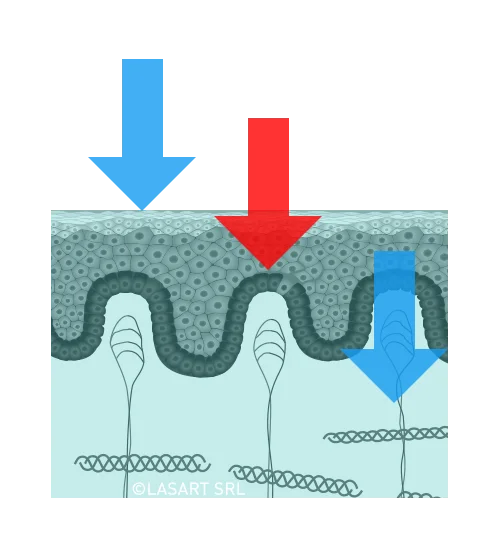
Hyaluronic Acid
>1000 kDa
does not pass beyond the stratum corneum → superficial action
Hyaluronic Acid
< 10 kDa reaches the dermis → clinically safe
Hyaluronic Acid
>20-300 kDa penetrates the epidermis → TLR4 risk
High molecular weight | Low molecular weight | Oligomers | |
Penetration | Skin surface only | Epidermis, stratum corneum | Up to the dermis |
Production method | Native bacterial fermentation | Chemical or enzymatic hydrolysis | Precision fermentation |
Inflammatory effect | Neutral / anti-inflammatory | Potentially pro-inflammatory | Neutral / anti-inflammatory |
Hydration | Superficial, immediate smoothing effect | Medium depth | Deep |
This distinction is not theoretical: Raman spectroscopy studies on human skin explants have shown that high molecular weight HA does not penetrate the stratum corneum, while molecules between 100 and 300 kDa penetrate the epidermis, and those below 50 kDa reach the deeper layers. Oligomers below 10 kDa have also been detected in the dermis.
The Biological Paradox - When the "Useful" Ingredient Becomes a Problem
This is the crux of the article, and it deserves a detailed explanation.
In healthy, intact skin, endogenous high molecular weight hyaluronic acid is biologically inert when compared to immune system receptors. It simply performs its structural function without triggering cellular responses.
However, when tissue is damaged - trauma, a burn, exposure to UV radiation, or laser treatment - something specific happens: enzymes present at the site of injury (hyaluronidase, oxygen free radicals) degrade the native, high-molecular-weight HA, breaking it into smaller fragments. These fragments act as endogenous danger signals, technically called DAMPs (Damage-Associated Molecular Patterns): they bind to the TLR4 receptor on keratinocytes and macrophages, activating the inflammatory response.
It's a physiological and intelligent defense mechanism: the body uses fragments of its own tissue as an alarm. The problem arises when low molecular weight hyaluronic acid is applied externally, through a cosmetic, to skin that is already sensitized or has a compromised barrier.
In this case, exactly the same thing can happen: small molecules penetrate the skin, reach the TLR4 receptors and trigger an inflammatory response that is not an allergy - it is not mediated by IgE, it is not predictable with a classic patch test - but it is a silent innate immune response.
Scientific literature provides clear data: hyaluronic acid fractions with a molecular weight of 20 kDa or less significantly increase the expression of TNF-α, one of the main pro-inflammatory cytokines. This evidence has led researchers to recommend avoiding topical use of these fractions on sensitive skin.
The problem of the production method
Understanding how low molecular weight hyaluronic acid is produced is crucial, as not all "low molecular weight" hyaluronic acid is created equal.
Chemical or enzymatic hydrolysis. The classic process starts with high molecular weight hyaluronic acid - obtained by bacterial fermentation - and breaks it down into smaller molecules through chemical reactions or the action of enzymes. The result is a mixture of fragments of heterogeneous sizes, difficult to precisely control. This process inevitably produces a variable MW range and potentially fragmentation byproducts.
Precision Fermentation. A more recent technology uses engineered microorganisms - typically yeast (Saccharomyces cerevisiae) - programmed to directly synthesize hyaluronic acid molecules of the target size, bypassing the degradation of larger chains. The result is a homogeneous molecule of controlled molecular weight, free of fragmentation byproducts.
The practical difference is significant: clinical studies conducted on a 3 kDa oligomer produced by precision fermentation have demonstrated that this molecule - despite penetrating living epidermis - does not induce any pro-inflammatory cytokines, including TNF-α, IL-1β, or IL-1α, either under normal conditions or under conditions of skin stress. Safety tests have also ruled out sensitizing, mutagenic, and genotoxic activity.
This apparently resolves the paradox: a small, deeply penetrating molecule can be safe - provided it is produced by a method that guarantees purity and molecular uniformity, without the irregular fragments typical of hydrolysis.
Sensitive skin and a compromised barrier: when the risk increases
With an intact skin barrier, the risk of HA from hydrolysis is limited: the stratum corneum functions as a physical filter and slows the penetration of larger molecules.
The situation changes radically when the barrier is damaged or temporarily compromised. This occurs in many common conditions:
- Chronic reactive skin - rosacea, seborrheic dermatitis, couperose
- After aesthetic treatments - fractional laser, intense pulsed light (IPL), photorejuvenation, chemical peels
- Sunburn - even moderate
- Dry skin with cracking of the stratum corneum
- Contact or atopic dermatitis in the acute phase
Under all these conditions, the skin barrier loses its selective ability: any molecule penetrates more rapidly and reaches deeper layers than normal. In this context, hydrolyzed low-molecular-weight HA comes into direct contact with the TLR4 receptors in the dermis in concentrations and at rates that would not occur under normal conditions.
The final paradox is bitter: those who most need a repairing and hydrating cosmetic - because their skin is inflamed, dry, and recovering - are also the people most at risk with the wrong choice of hyaluronic acid.
→Learn more: Skin care after laser hair removal
→ Learn more: Facial photorejuvenation: how to care for your skin after pulsed light therapy
→ Learn more: Post-laser hyperpigmentation: causes and prevention
How to read the label - a practical guide
The practical problem is that the molecular weight of hyaluronic acid is not required on labels according to European cosmetic regulations. The INCI name ("Hyaluronic Acid" or "Sodium Hyaluronate") provides no indication of the molecule's size.
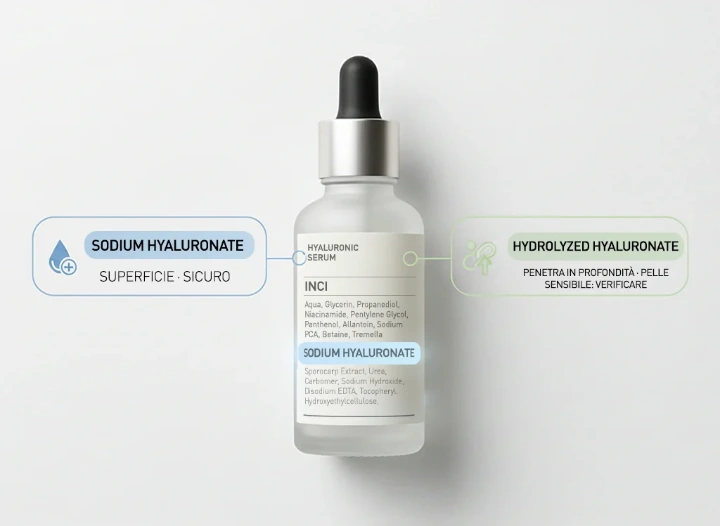
Some useful signs to help you find your way:
Sodium Hyaluronate
The sodium salt of hyaluronic acid. It can be high or low molecular weight. Without further specification, it is often high molecular weight HA from classical fermentation.
Hydrolyzed Sodium Hyaluronate
It explicitly indicates that the molecule was obtained by hydrolysis, therefore having a low molecular weight. Use with caution on sensitive or recovering skin.
Sodium Hyaluronate Crosspolymer
Chemically cross-linked HA. A hybrid form with specific characteristics, used primarily for volumizing effects.
Lack of information on the MW → The general rule: the more transparent the brand is about the type of HA used and the related production process, the more likely it has made informed choices. Look for active communication on product sheets or in the ingredients section.
Practical recommendation:
- Normal skin, barrier intact: Hydrolyzed HA is generally acceptable and offers good penetration
- Sensitive, reactive skin, recovering post-treatment: favor formulations that declare high MW or precision fermentation oligomers, explicitly avoiding low MW hydrolyzed fractions
Frequently asked questions
Is hyaluronic acid dangerous?
No, generally speaking, hyaluronic acid is a safe ingredient with a long history of clinical and cosmetic use. The key is not the danger of the molecule itself, but the variability of its effects based on its molecular weight and production method. An informed choice reduces the risk of adverse reactions, especially on sensitive skin.
How long does it take to see results?
There could be various causes-other ingredients in the formula, pH, preservatives - but if the product contains "hydrolyzed sodium hyaluronate" and your skin is reactive or in a recovery phase, the low molecular weight hydrolyzed fraction could be a factor. It's not a classic allergic reaction: it's an innate immune response mediated by TLR4 receptors.
Is high molecular weight hyaluronic acid useless if it remains on the surface?
Absolutely not. High-MW AIA forms a hydrating film on the skin's surface, slows transepidermal water loss (TEWL), and immediately improves skin texture and appearance. It plays a different role - not worse - than the penetrating molecules. In more comprehensive formulations, different HA fractions are combined to act on multiple levels.
What is the difference between "Sodium Hyaluronate" and "Hydrolyzed Sodium Hyaluronate"?
"Sodium Hyaluronate" without a prefix typically indicates the native, high molecular weight molecule. "Hydrolyzed" indicates that the molecule has been degraded to obtain smaller fragments. The INCI distinction is useful in this case, although it doesn't provide the exact MW value.
What does precision fermentation mean?
It is a biotechnological process in which an engineered microorganism (e.g., a modified yeast) directly produces hyaluronic acid of the desired molecular size, without having to fragment larger chains. The result is a more uniform and controlled molecule than traditional hydrolysis, with a clinically documented safety profile even for very small sizes (up to 3 kDa).
Should low molecular weight HA always be avoided?
No. The risk primarily concerns fractions around 10-20 kDa obtained by hydrolysis on skin with a compromised barrier. Very small oligomers (<10 kDa) produced by precision fermentation exhibit a different profile and, according to clinical studies, do not induce pro-inflammatory cytokines. The assessment must take into account the production method, the specific MW, and the consumer's skin condition.
Conclusion
Hyaluronic acid remains one of the most effective and versatile ingredients in modern cosmetics. But "hyaluronic acid" isn't a single entity: it's a family of molecules with profoundly different biological behaviors. Size matters, production method matters, and the condition of the skin to which it's applied matters.
For those with perfectly balanced skin, most formulations on the market are acceptable. However, for those in a delicate phase - after a cosmetic treatment, with a weakened barrier, or with reactive skin - knowing these distinctions can make the difference between a product that helps and one that worsens the situation.
Knowing the ingredient is the first tool for an informed choice.
→ Hyaluronic Acid: A Complete Guide to the Ingredient
→ Redness after laser hair removal: causes and remedies
→ Sunburn: What to Do and How to Treat It
Scientific references
- Zanchetta C., Scandolera A., Reynaud R. Hyaluronic Acid in Topical Applications: The Various Forms and Biological Effects of a Hero Molecule in the Cosmetics Industry. Biomolecules. 2025;15(12):1656.
- De Tollenaere M., Corriou A., Durduret A. et al. In Vitro and Ex Vivo Investigations on the Tolerance and Safety of a 3 kDa Sodium Hyaluronate for Topical Application. Cosmetics. 2025;12(6):266.
- Gariboldi S., Palazzo M., Zanobbio L. et al. Low Molecular Weight Hyaluronic Acid Increases the Self-Defense of Skin Epithelium by Induction of β-Defensin 2 via TLR2 and TLR4. The Journal of Immunology. 2008;181(3):2103–2110.
- Farwick M. et al. Low molecular weight hyaluronic acid: its effects on epidermal gene expression and skin ageing. Cited in: Update on Low-Molecular Weight Hyaluronic Acid in Dermatology: A Scoping Review. European Medical Journal Dermatology. 2024.
- Essendoubi M., Gobinet C., Reynaud R. et al. Human skin penetration of hyaluronic acid of different molecular weights as probed by Raman spectroscopy. Skin Research and Technology. 2016;22(1):55–62.
- McKee C.M., Penno M.B., Cowman M. et al. Hyaluronan (HA) fragments induce chemokine gene expression in alveolar macrophages. Journal of Clinical Investigation. 1996;98(10):2403–2413.
- Campo G.M., Avenoso A., Campo S. et al. Molecular size hyaluronan differently modulates toll-like receptor-4 in LPS-induced inflammation in mouse chondrocytes. Biochimie. 2010;92(2):204–215.
- Update on Low-Molecular Weight Hyaluronic Acid in Dermatology: A Scoping Review. European Medical Journal Dermatology. Published March 27, 2025.