
Why some cosmetics make melasma worse
Melasma isn't just a response to sun exposure. It's also a response to inflammation, disruption of the skin barrier, and any stimulus that activates melanocytes. This means that even a seemingly neutral cosmetic product can become an aggravating factor if it contains photosensitizing ingredients or ingredients that disrupt the skin's balance.
Choosing your skincare routine wisely is therefore an integral part of any melasma treatment plan. It's not about avoiding cosmetics altogether, but rather reading labels carefully and knowing which substances are best avoided in the presence of this condition.
This article is for informational purposes only and does not replace the advice of a dermatologist. Do not make any changes to your routine or current treatment without first consulting your doctor.
Photosensitizing ingredients: the highest-risk category
The term "photosensitizer" refers to substances that, once applied to the skin, increase the skin's reaction to ultraviolet light. In the context of melasma, the consequence is direct: increased sensitivity to UV rays means greater stimulation of melanogenesis and, potentially, worsening of the spots.
Essential oils with furocoumarins
Some families of essential oils contain furocoumarins, natural compounds with strong photosensitizing properties. Furocoumarins bind to cellular DNA in the presence of UV light and can trigger a local inflammatory response that stimulates melanin production.
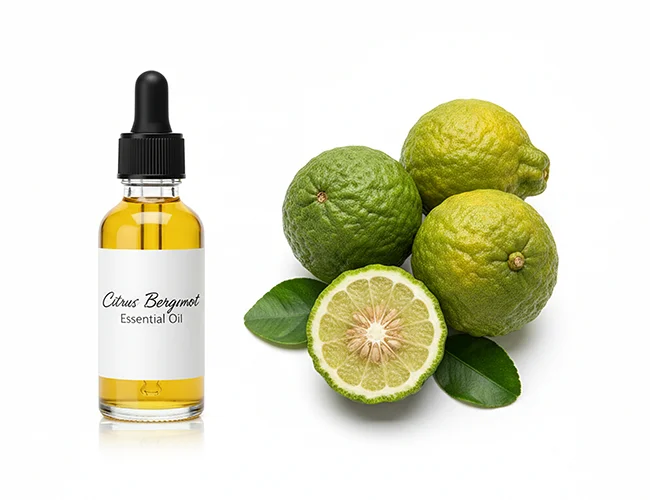
Oils to avoid or use with extreme caution include:
- Bergaptene / non-debergaptene bergamot oil: it is the most documented natural photosensitizer in cosmetics
- Cold-pressed lemon essential oil
- Bitter orange oil (Citrus aurantium)
- Angelica oil (Angelica archangelica): among the most powerful photosensitizers in its category
- Celery oil and other umbelliferous plants
Caution: Essential oils obtained by steam distillation are generally free of furocoumarins (which do not distill), while those obtained by cold pressing contain them. This distinction is not always clear on labels: when in doubt, choose products that do not contain the oil or are declared "bergapten-free."
AHA (alpha hydroxy acids)
Alpha-hydroxy acids, such as glycolic acid, lactic acid, and mandelic acid, are not strictly photosensitizing, but they increase cell turnover by reducing the thickness of the stratum corneum. The result is thinner skin that is more vulnerable to UV rays in the short term.
When used correctly, in the evening and combined with an adequate sunscreen (such as an SPF 50 face cream or an SPF 30 physical sunscreen), AHAs can also be associated with melasma. The problem arises from morning use, the lack of SPF, or excessive concentrations that destabilize the skin barrier. In these cases, the risk of worsening is real.
Retinoids for daytime use
Retinoids, including tretinoin and newer-generation retinoids likeoleyl adapalenate, are photosensitive molecules that degrade in light and increase the skin's sensitivity to UV rays. They should be used properly only in the evening. Applying them in the morning, even unintentionally (for example, in multi-purpose creams), exposes the skin to a high risk of erythema and, ultimately, post-inflammatory hyperpigmentation.
Irritating ingredients: the inflammation–melanin mechanism
Any form of skin irritation, even mild and invisible, can be enough to activate melanocytes. Stressed keratinocytes release inflammatory mediators such as IL-1, TNF-α, and prostaglandins, which, by acting on pigment cells, increase melanin synthesis. This is the mechanism underlying post-inflammatory hyperpigmentation and also applies to melasma.
Denatured alcohol (Alcohol Denat.)
Denatured alcohol is a widely used solvent in cosmetic formulations due to its ability to promote the penetration of active ingredients and provide an immediate sensation of freshness. The problem is that it alters the skin's lipid barrier, promotes transepidermal water loss (TEWL), and, over time, induces a state of chronic microinflammation. For those with melasma, this disruption should be avoided. Labels may include the following: Alcohol, Alcohol Denat., SD Alcohol, or Isopropyl Alcohol.
Not all alcohols are problematic: fatty alcohols such as cetearyl alcohol or behenyl alcohol have an emollient function and do not present this risk.
Menthol and camphor
Menthol and camphor are ingredients with a "cooling" and mild anesthetic effect, used in some soothing creams and after-sun products. Both can be sensorially pleasant but are classified as potential irritants and sensitizers, especially on skin with a compromised barrier. If you have melasma or a difference in melasma that has not been clinically proven, it's best to avoid them.
Aggressive detergents (SLS/SLES)
Sodium lauryl sulfate (SLS) and sodium laureth sulfate (SLES) are surfactants with good foaming properties but are known to alter the skin's hydrolipidic film. Repeated cleansing with these ingredients weakens the skin barrier and increases the skin's reactivity to external stimuli. For daily cleansing, if you have melasma, it's best to choose cleansers with gentle surfactants based on glucosides or sarcosinates, which maintain the integrity of the microbiota and skin film.
Hydroquinone: Banned in the European Union
Hydroquinone has historically been considered the gold standard for the treatment of hyperpigmentation. It inhibits tyrosinase, the key enzyme in melanin synthesis, with documented efficacy. However, the European Union has banned its use in consumer cosmetics in Annex II of Regulation (EC) 1223/2009. The ban is absolute: no concentration is permitted.
The reasons for the European ban include: the risk of exogenous ochronosis (paradoxical blue-black pigmentation with prolonged use), potential cytotoxicity, and classification as a possible carcinogen based on experimental data. The complete guide to hydroquinone explores these issues in more detail.
Warning: Despite the ban, the product is still available in some non-European markets. Anyone purchasing cosmetics outside the EU, even online, should check the composition. Products purchased outside of Europe may contain hydroquinone without any obvious labeling in Italian.
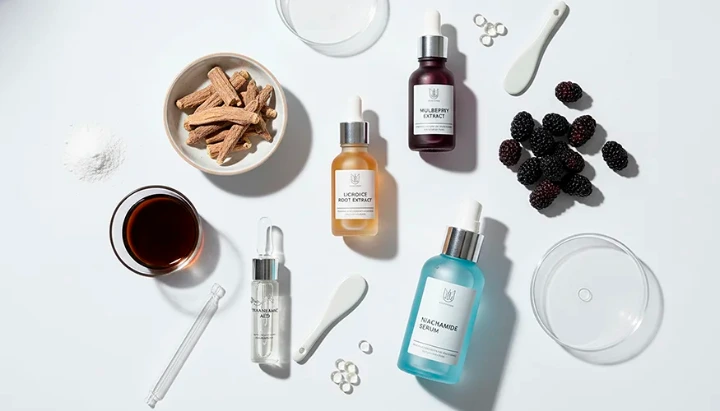
What to Choose Instead: Melasma-Safe Ingredients
Eliminating problematic ingredients is only half the battle. The other half is building a routine with ingredients that actively support melasma management without exposing the skin to additional risks.
Tranexamic acid
Tranexamic acid is currently considered one of the safest and most well-tolerated melanogenesis inhibitors available in cosmetics. It works by interfering with plasminogen-mediated communication between keratinocytes and melanocytes, selectively reducing melanin synthesis. It does not sensitize or irritate skin and can be used year-round, even in the summer months when combined with sunscreen.
Niacinamide
Niacinamide (vitamin B3) inhibits the transfer of melanosomes from melanocytes to keratinocytes, reducing the amount of pigment reaching the skin's surface. It is a multifunctional ingredient with anti-inflammatory and sebum-regulating properties, well-tolerated by almost all skin types.
Tetraidrocurcumin
Tetraidrocurcumin is the hydrogenated metabolite of curcumin, with antioxidant and tyrosinase inhibitory properties. Unlike curcumin, it is colorless and stable in cosmetic formulations. It has a high tolerability profile, even on darker skin types.
Licorice extract (Glycyrrhiza glabra)
Licorice extract contains glabridin and licorice, two compounds with proven tyrosinase inhibitory activity. Glabridin, in particular, acts on multiple stages of melanogenesis and is also a cyclooxygenase (COX) inhibitor, giving it a significant anti-inflammatory effect in the treatment of melasma. It is a safe, well-tolerated ingredient, and compatible with all skin types.
Mulberry extract (Morus alba)
White mulberry extract is rich in oxyresveratrol and other polyphenols with depigmenting properties. It inhibits tyrosinase with a potency comparable to hydroquinone in some in vitro studies, without the associated toxicity. It is a leading ingredient in hydroquinone-free depigmenting formulations.
Mineral filters: zinc and titanium
Zinc oxide and titanium dioxide -based sunscreens are the first line of defense in the treatment of melasma. They physically reflect UV rays without triggering chemical reactions in the skin, are stable in light, and do not cause photosensitivity. They are the preferred choice in clinical protocols for melasma, especially in skin phototips and above. The SPF Melicor range is entirely based on mineral filters.
The role of sunscreen in managing melasma
No depigmenting ingredient works without sunscreen. Daily sunscreen is both the most effective preventative measure and a prerequisite for any treatment. Even on cloudy days or in closed environments with exposure to visible light, melanocytes in those with melasma can remain activated.
The Hydroquinone-Free Melasma Protocol details how to combine safe ingredients and sun protection into a consistent routine.
Frequently Asked Questions
Can I use vitamin C if I have melasma?
Vitamin C (ascorbic acid) is generally compatible with melasma, thanks to its antioxidant activity and ability to reduce melanin oxidation. The critical issue is stability: pure ascorbic acid oxidizes rapidly and, once degraded, can cause irritating effects. Stabilized formulations (ascorbyl glucoside, ascorbyl tetraisopalmitate) at low concentrations are preferred.
Do vegetable oils make melasma worse?
Not directly. Non-photosensitizing plant oils, such as argan oil, jojoba oil, or rosehip oil, do not worsen melasma. The problem only affects plants containing furocoumarins (see the section on essential oils). Pure carrier oils, free of essential oils, are generally safe.
Is retinol contraindicated for melasma?
No, but it must be used correctly. Retinol and retinoids in general can be useful in treating melasma by promoting cell turnover. The basic rule is evening use combined with morning sunscreen. Daytime application without SPF is contraindicated.
What should I do if I have already used a hydroquinone product purchased outside the EU?
Discontinue use and consult a dermatologist. Your doctor will be able to evaluate any adverse effects (ochronosis, paradoxical hyperpigmentation) and recommend an alternative treatment with safe, European-approved molecules.
Information note
The information in this article is for educational purposes only and does not constitute medical advice, a diagnosis, or a treatment plan. Each case of melasma is different and depends on individual factors that only a dermatologist can properly evaluate. Do not change your cosmetic routine or discontinue any ongoing treatments without first consulting your doctor.
Sources and scientific references
- Passeron T. et al. (2020). Position statement for the treatment of melasma in adults. Journal of the European Academy of Dermatology and Venereology, 34(7), e291–e295.
- Regolamento (CE) n. 1223/2009 del Parlamento Europeo e del Consiglio del 30 novembre 2009 sui prodotti cosmetici. Allegato II – Sostanze vietate. Voci 1339 (idrochinone).
- Zhu W. et al. (2016). A multi-centre, double-blind, randomized controlled comparative study of the efficacy and safety of hydroxyphenoxy propionic acid vs hydroquinone in subjects with melasma. Journal of Cosmetic Dermatology.
- Hollinger JC. et al. (2018). Are Natural Ingredients Effective in the Management of Hyperpigmentation? A Systematic Review. Journal of Clinical and Aesthetic Dermatology, 11(2), 28–37.
- Sarkar R. et al. (2013). Melasma in Men: A Review of Clinical, Etiological and Management Issues. Journal of Clinical and Aesthetic Dermatology, 6(1), 44–48.