
The 808 nm diode laser is currently the most widely used system in clinics and medical aesthetic centers for permanent laser hair removal. Its popularity is no coincidence: it combines clinically documented efficacy with a superior safety profile compared to other systems, and can be used on a wider range of skin types than alexandrite lasers. In this article, we explain how it works, who can undergo the treatment, and how to care for your skin in the weeks following the session.
What is the 808 nm diode laser
The diode laser is a solid-state laser system that emits light at a wavelength of approximately 808 nanometers. This wavelength falls within the optical window of the skin: it is selectively absorbed by the melanin in the hair follicle, penetrating deep into the dermis and damaging the structures responsible for hair growth without affecting the surrounding tissue.
A clarification on the nomenclature. Beauty salon price lists and device data sheets use different terms: 805 nm, 808 nm, and 810 nm. These differences have no clinical significance. They are the same technology: the variations are within the manufacturing tolerances of the laser diodes and do not affect efficacy or safety. The term "808 nm" has become the conventional market reference.
Not all diode lasers are created equal. From a technical point of view, diode systems are divided into two main categories:
Long-pulse lasers operate at relatively low peak power. They are less expensive to produce, making them more popular in budget-conscious centers. Their effectiveness is lower than high-power systems, and they often require more sessions to achieve comparable results.
High-power short-pulse lasers focus energy much more quickly, reaching follicular temperatures sufficient to cause permanent damage in the first few sessions. They are more expensive, but are the standard in specialized medical centers.
This distinction is important because the number of sessions required depends largely on the actual power of the system used, not on the type of laser itself.
Why the 808nm diode laser is considered the gold standard
Among all the laser systems approved for permanent hair removal, the 808 nm diode has established itself as the reference for three main reasons.
Effective on a wide range of skin types. The 808 nm wavelength is effectively absorbed by hair melanin, but to a lesser extent by epidermal melanin than shorter-wavelength lasers. This allows for the safe treatment of skin types I to V, and even skin type VI under controlled conditions. Alexandrite lasers (755 nm), while effective and very fast, have energy absorbed more by the epidermis and are not suitable for skin types V and VI. Diode lasers therefore cover a wider range of users.
Affordability. Diode systems are more efficiently manufactured on an industrial scale than alexandrite systems. This translates into lower purchase and maintenance costs for centers, which can translate into more affordable rates for patients.
Favorable safety profile. Compared to shorter wavelength lasers, the 808 nm diode carries a lower risk of epidermal damage in darker or lightly tanned skin. The therapeutic window is wider, reducing the margin of error in the case of suboptimal settings.
How the session works
During the session, the laser handpiece is applied in contact with the skin. Most modern systems integrate an active tip cooling system, which lowers the surface temperature of the epidermis at the moment of the pulse, protecting it from heat and making the procedure more tolerable.
The laser pulse reaches the hair follicle, where melanin absorbs the light energy and converts it into heat. The heat spreads to the surrounding structures of the follicle, causing controlled thermal damage that inhibits the hair's ability to regrow. The procedure is only effective on hair in the anagen (active growth) phase, because it is during this phase that the follicle contains melanin. Hair in the telogen (resting) phase does not respond to the treatment.
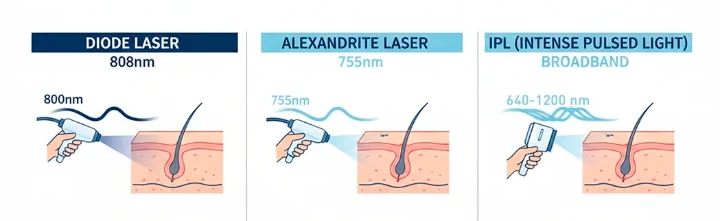
Difference between diode laser and IPL. IPL (Intense Pulsed Light) is not a laser but a broad-spectrum light source. For hair removal, IPL systems typically emit a wavelength range from 640 to 1200 nm (with variable filters). This spectral breadth has a paradoxical effect: on the one hand, the shorter wavelengths in the range are also absorbed by epidermal melanin, forcing the operator to work with lower fluences to avoid burns, which limits effectiveness on the follicle. On the other hand, the presence of variable wavelengths can make IPL more effective than diode or alexandrite lasers on red hair, because pheomelanin (the red pigment) absorbs certain portions of that spectral range better. For most hair types and skin types, diode lasers guarantee greater precision and safety.
Who is the 808 nm diode laser suitable for
The diode laser is indicated for skin phototypes I to V according to the Fitzpatrick classification. For phototypes IV and V, careful selection of treatment parameters, particularly fluence and pulse duration, is necessary to maintain epidermal safety. Phototype VI can be treated in specialized medical centers with specific protocols and high-power systems.
The optimal condition for treatment is the presence of dark hair (black or brown) on untanned skin. Light, very light blonde, red, or gray hair responds poorly or not at all, regardless of the type of laser used: the reason is biological and depends on the melanin composition of the hair (see the FAQ section).
For a detailed comparison with the alexandrite laser, useful for understanding which system is best suited for your skin type, you can consult the article dedicated to thelaser hair removal with alexandrite.
Main contraindications. The session should be postponed if you have a recent tan, even from sunbeds. You should inform your doctor if you are taking photosensitizing medications (certain antibiotics, highly concentrated topical retinoids, anti-inflammatories). Pregnancy is an absolute contraindication. Some active skin conditions in the treatment area may require a preliminary medical evaluation.
The recovery phases after the session
Knowing what to expect after each session helps you distinguish normal reactions from signs that deserve attention, and avoid compromising the results with inappropriate behaviors in the hours and days that follow.
1-24 hours
Immediately after the session, perifollicular redness appears, a pinkish halo around each treated hair, often accompanied by mild follicular edema. The skin may feel "orange peel" and warm to the touch. These reactions confirm that the treatment has reached the follicle and are entirely expected. During this phase, it is essential to avoid heat: saunas, hot baths, intense exercise, and any external heat source should be postponed for at least 24 hours. Direct sunlight should be avoided, and if necessary, going outside, a broad-spectrum sunscreen is mandatory.
Days 2-5
In the days following the session, the treated hairs begin to fall out or appear to be growing. This is a common misconception: this isn't new growth, but rather the process by which damaged hair is expelled from the follicle. In hairs in the anagen phase, the bulb has been destroyed, and the remaining hair is gradually eliminated from the skin. Do not attempt to remove it with tweezers, waxing, or other mechanical methods: the skin in this phase is sensitized, and any additional trauma increases the risk of irritation or hyperpigmentation.
Days 5-14
The skin gradually returns to normal. The sensation of heat and tightness disappears. During this time, it is important to continue avoiding prolonged sun exposure and to maintain sunscreen on the treated areas if exposed to daylight. Shaving residual hair with a razor is acceptable if necessary, but any other mechanical or chemical hair removal method is contraindicated between sessions, as it would remove the hair from the follicle, compromising the anagen phase of the next session.
Post-diode laser hair removal care protocol
Proper skin care in the hours and days following the session helps reduce inflammatory reactions, protect the skin barrier, and prevent complications such as post-inflammatory hyperpigmentation. The protocol is divided into three steps.
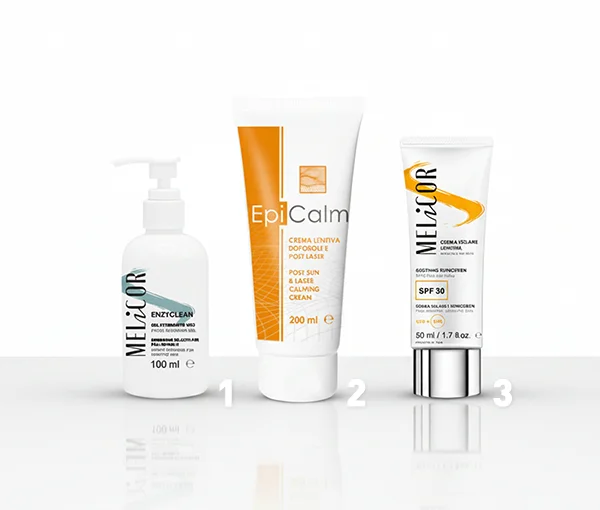
Step 1: Gentle cleansing. In the hours following the session, and in the days immediately following, the skin does not tolerate cleansers with harsh surfactants, perfumes, or exfoliating ingredients. A cleansing gel formulated for sensitive skin, with a physiological pH and free of irritants, allows you to cleanse the skin without compromising the hydrolipidic film, already weakened by the thermal reaction.Enzyclean cleansing gel meets these criteria, with a mallow-based formulation and no comedogenic components, suitable for the large surfaces treated during laser hair removal.
Step 2: Soothing and restorative care. The post-session inflammatory reaction requires a product that performs multiple functions simultaneously: calming redness, supporting the skin barrier's regeneration, and maintaining an adequate level of hydration without clogging the follicles. For areas of the body (legs, arms, abdomen, back), where the skin is thicker and the reaction is typically less intense, a light, highly tolerable soothing cream likeEpicalm Soothing Cream is the right choice. For areas of the face, neck or décolleté, where the skin is thinner and the need for deeper repair is greater, it is preferable to use a repairing product with a higher concentration of regenerating active ingredients, such asEpicalm Plus repairing cream.
Step 3: Sun protection with physical filters. After each laser hair removal session, sunscreen is not an optional recommendation but a physiological necessity. Treated skin has a temporarily compromised barrier and an increased susceptibility to UV radiation, which can trigger or aggravate a hyperpigmentation reaction. The choice of sunscreen is important in this context: during laser hair removal, large body surfaces (legs, bikini line, armpits, back) are often treated, and the area of application of sunscreen is consequently very large. Creams with chemical filters are absorbed through the skin to a greater extent than physical filters, and this difference becomes more significant over large areas. Physical filters based on mineral oxides, such as titanium dioxide and zinc oxide, form a barrier on the skin's surface without penetrating and are the safest choice when sunscreen must be applied daily to large areas. Mineral Sunscreen SPF 50 and Mineral Sunscreen SPF 30 are formulated with physical filters certified for sensitive skin, suitable for post-laser.
Complete post-laser hair removal kit
Diode laser and the risk of hyperpigmentation
The risk of developingpost-inflammatory hyperpigmentation (PIH) after diode laser hair removal is present but moderate, lower than that of a CO₂ or ablative laser, and comparable to that of alexandrite for fair skin types. The risk increases in skin types IV and V, in the presence of a tan, and when the skin is exposed to the sun without protection in the weeks following the session.
Hyperpigmented spots form because the inflammatory reaction stimulates melanocytes to produce excess melanin. Preventing them means minimizing post-session inflammation (proper management of the first 24 hours) and protecting the skin from UV rays in the following weeks. For skin types IV and V with a documented tendency toward hyperpigmentation, a preventative depigmenting cream may be recommended between sessions, which should be discussed with the treating physician. Lumicor anti-hyperpigmentation creame based on tranexamic acid is one of the options formulated for this purpose.
How many sessions are really needed
The number of sessions required for laser hair removal depends on the physiology of the hair growth cycle, not the type of laser used. Alexandrite, diode, Nd:YAG, and IPL lasers, if properly sized and adjusted, require the same number of treatments because they must target hairs in the same growth phase (anagen), with the same percentages of follicular activity per body area.
With a high-powered system and correct settings, 4 to 6 sessions are sufficient for permanent hair removal in many cases, with a maximum of 8 sessions in the most stubborn cases. When a professional indicates the need for 10 or more sessions, it's important to consider two possibilities: either the system used is insufficiently powerful, or the treatment settings aren't optimal for the patient's hair type and skin type.
There is a small percentage of patients, estimated at around 3-5%, who have individual characteristics in the composition of follicular melanin that reduce the response to treatment, regardless of the equipment and technique. In these cases, results are still present, but require a slightly higher number of sessions. This is a rare condition, and not the norm.
Frequently asked questions
How harmful is the 808nm diode laser?
The sensation during the session depends on the area treated, the power setting, and the handpiece's cooling system. Areas with a higher concentration of follicles and thinner skin (groin, armpits, upper lip) are generally more sensitive. Most patients describe the sensation as a pinch or a light pop, tolerable without anesthesia. Modern systems with integrated cooling have significantly reduced discomfort compared to first-generation lasers.
What is the difference between diode laser and alexandrite laser?
The alexandrite laser (755 nm) is slightly more effective on very fine hair in light skin types and ensures faster sessions thanks to its larger spot size. However, its shorter wavelength increases the risk of epidermal damage in darker skin types and is not suitable for skin types V and VI. The diode laser (808 nm) is less selective on the epidermis, can be used safely up to skin type V and in medical settings even on skin type VI, and is more suitable for those with olive or dark skin. For an in-depth comparison between the two systems, read the article onlaser hair removal with alexandrite.
Can I have diode laser treatment in the summer?
Summer isn't an absolute contraindication, but it does require extra care. The main rule is that skin should not be tanned at the time of the session. A recent tan increases the concentration of epidermal melanin, which competes with follicular melanin for absorption of laser energy, increasing the risk of burns and reducing effectiveness. If you manage to keep the treated areas protected from sun exposure in the weeks before and after the session, treatment is possible even in summer.
How many sessions are really needed for permanent hair removal?
With a properly adjusted high-power system, most patients require 4–6 sessions to achieve permanent hair removal. The maximum expected number is 8 sessions. When 10 or more sessions are recommended, it's best to ask for clarification on the equipment used and the treatment parameters, as the problem is generally not the patient's fault.
What should I not do in the 24–48 hours after the session?
For the first 24–48 hours, avoid direct sun exposure, saunas, Turkish baths, very hot showers or baths, intense physical activity, creams containing acids or retinoids, and alcohol-based spray deodorants in the treated armpit areas. These precautions help prevent the inflammatory reaction already underway in the skin.
Does the diode laser work on light, red, or gray hair?
The diode laser, like all laser hair removal systems, targets the melanin in hair. Very light blond hair contains little eumelanin (the dark pigment) and responds poorly. Red hair contains predominantly pheomelanin, a pigment that absorbs the diode laser's wavelengths inefficiently, resulting in limited results. Gray and white hair contains no melanin and does not respond to any of its variants. In these cases, the IPL system may offer slightly better results on red hair thanks to its broad spectrum, while for gray hair, electrolysis remains the only effective alternative. In patients with mixed hair (dark and gray or light), the laser works effectively on pigmented hair.
The Melicor kit for post-laser hair removal
To simplify the routine in the weeks between sessions, Melicor has created a three-product protocol that covers all three steps of post-laser care: gentle cleansing, soothing and repairing action, and sun protection with physical filters. The complete post-laser hair removal kit is available in the shop and can also be requested as a routine to be maintained for the entire duration of the session cycle.