
The Er:YAG erbium laser is one of the most popular skin resurfacing treatments in the medical-aesthetic field. Compared to other ablative lasers, such as the fractional CO₂ laser, it has a more favorable safety profile and a generally shorter recovery time. This makes it a popular choice for both physicians and patients seeking a visible improvement in skin quality with less impact on daily life.
Understanding how this laser works, what happens to the skin in the days following the session, and how to properly manage recovery is essential to achieving the desired results and preventing the most common complications, primarily post-inflammatory hyperpigmentation.
How the Er:YAG erbium laser works
The Er:YAG laser emits radiation at a wavelength of 2940 nm, which corresponds to the peak water absorption in biological tissue. This means that the laser energy is absorbed extremely efficiently by the water-rich surface layer of the skin, producing precise and controlled vaporization of the tissue without dispersing into the deeper layers.
The practical consequence is a much smaller area of residual thermal damage: the surrounding tissue is affected to a lesser extent than with the CO₂ laser. This characteristic makes the Er:YAG an ablative laser with a more "surgical" and predictable behavior, where the action is almost entirely confined to ablation, i.e., the mechanical removal of tissue, with a very limited deep heating component.
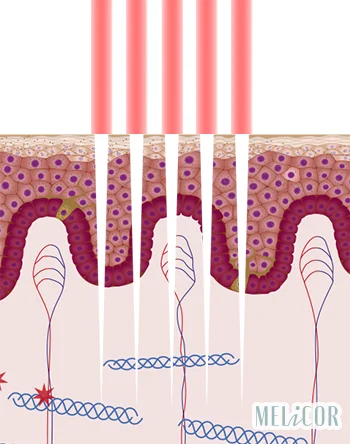
The process stimulates skin regeneration: the skin responds to the ablation by activating tissue repair mechanisms, resulting in the production of new collagen and progressive re-epithelialization. The result, in the following weeks, is an improvement in texture, a reduction in surface irregularities, and, in the case of scars or discoloration, a progressive evenness of skin tone.
For whom it is indicated
The Er:YAG laser is suitable for all phototypes, from I to VI according to the Fitzpatrick classification. This versatility distinguishes it from the CO₂ laser, the use of which on dark skin types requires greater caution due to the high risk of post-inflammatory hyperpigmentation.
The main indications include superficial and medium-thickness wrinkles, skin texture irregularities, shallow acne scars, sunspots, and some forms of lentigo. It is also used for rejuvenation of the eye contour, neck, and décolleté, areas where the precision of the ablation and reduced thermal risk represent a significant advantage.
However, it is not the best choice when seeking deep firming effects or the treatment of very pronounced wrinkles: in these cases, the CO₂ laser, with its greater thermal component, offers more pronounced results with the same number of sessions. The main contraindications include the presence of active infections in the treatment area, ongoing retinoid therapy, and immunosuppression; the evaluation should always be carried out by a doctor before the session.
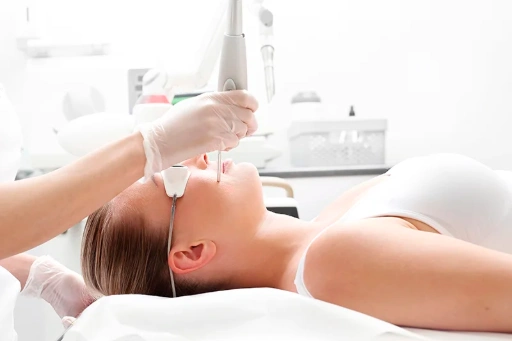
What to Expect: The Stages of Recovery
Recovery after the Er:YAG laser is generally quicker than that of the intensive fractional CO₂ laser, but still requires attention and care in the first few weeks. The typical sequence is divided into three phases.
Days 1–3. Immediately after the session, the skin appears red, swollen, and sensitive to the touch. The sensation is similar to that of a moderate sunburn: burning, heat, and, in some cases, superficial oozing in the most intensively treated areas. At this stage, the skin barrier is compromised, making it vulnerable to both external irritation and dehydration. This is when gentle cleansing and the application of a repairing product become top priorities. Avoiding all heat sources, even indirect sun exposure, and products containing alcohol or perfume is essential.
Days 4–7. Flaking begins to become visible: small layers of skin gradually peel off, a sign that re-epithelialization is underway. This phase is often accompanied by itching, which should not be relieved by scratching: mechanical abrasion can damage the newly forming skin layer and increase the risk of scarring. The skin may still be red and slightly tight. It is important to maintain skin hydration with products compatible with the repairing barrier.
Weeks 2–4. Re-epithelialization is gradually completed. Redness fades and the skin begins to take on its new appearance: more even, smoother. However, the skin is still more sensitive than normal to ultraviolet radiation, making sunscreen essential for at least four weeks, and preferably throughout the summer if the session occurred close to the warm season. During this phase, you can gradually reintroduce your normal routine, still avoiding more aggressive active ingredients such as chemical exfoliants.
Erbium laser post-treatment care protocol
Correct recovery management is divided into three fundamental steps, to be followed in sequence from the first morning after the session.
Step 1: Gentle cleansing. In the days following laser treatment, cleansing cannot be done with ordinary products. Conventional cleansers contain surfactants, fragrances, and preservatives that, on skin with a compromised barrier, cause irritation, delay healing, and can promote inflammatory reactions. Cleansing should be done with a product specifically formulated for sensitive and recovering skin, with a physiological pH and no irritating ingredients. Enzyclean facial cleansing gel is formulated to meet these requirements: it cleanses without attacking, prepares the skin for the next steps and does not interfere with the repair processes.
Step 2: Repair and Soothe. After cleansing, your skin needs a product that actively supports the regeneration of the skin barrier, reduces inflammation, and maintains adequate hydration. Epicalm Plus repair cream is formulated for the post-procedure phase following facial laser treatments, photorejuvenation, and vascular coagulation. Its light, low-comedogenic base makes it suitable for use even on thinner and more reactive facial skin, and it adapts well to the needs of re-epithelializing skin.
Step 3: Sunscreen. Sunscreen after Er:YAG laser is not an option, but a physiological necessity. The newly formed skin layer lacks the protection normally offered by the intact stratum corneum, and melanocytes are hyperreactive, making them much more sensitive to solar stimuli. Even brief, unintentional exposure can trigger a disproportionate melanogenic response. The optimal post-procedure sunscreen is mineral sunscreens, particularly zinc oxide and titanium dioxide, which are not absorbed by the skin and do not interact with healing tissue. The SPF 50 sunscreen for sensitive skin represents the reference protection for the face in the post-laser period.
How to prevent post-laser pigmentation
Post-inflammatory hyperpigmentation (PIH) is the most common complication after ablative laser treatments. It manifests as the appearance of dark spots in the weeks following the session, resulting from excessive melanocyte activation stimulated by skin inflammation.
Although the Er:YAG laser presents a lower risk of PIH than the CO₂ laser, this risk is not absent, particularly in subjects with phototypes III, IV, V and VI. In darker phototypes, melanocytes are structurally more reactive and tend to respond more intensely to any inflammatory stimulus, including that produced by the laser.
Prevention involves two levels. The first is constant sun protection, as described in the previous protocol. The second is the use of a depigmenting agent capable of modulating melanin synthesis before the dark spots become established. Lumicor anti-hyperpigmentation cream is formulated for this purpose: it acts on the melanogenic cascade through active ingredients such as tranexamic acid and cetyl tranexamate mesylate, without resorting to hydroquinone. For a deeper understanding of the mechanisms of PIH and treatment strategies, the article onpost-laser hyperpigmentation offers a comprehensive guide.
The right time to start prevention with a depigmenting agent should be agreed with the doctor who performed the procedure, generally after complete re-epithelialization.
Erbium laser or CO₂ laser: which should you choose?
There is no universal answer, because the two lasers have different efficacy and safety profiles that make them suitable for different objectives.
The Er:YAG laser is more precise, less invasive, and allows for a quicker recovery. It is safe for all skin types and has a lower risk of complications. The limitation is that significant anti-aging results may require a greater number of sessions than CO₂.
The fractional CO₂ laser produces more pronounced effects on the thermal component of the tissue, stimulating deep collagen and achieving visible results in fewer sessions. However, it offers longer downtime and a higher risk of PIH, which requires a careful preventative plan, especially for skin type III and above.
The choice between the two depends on the type of problem to be treated, the skin type, the available recovery time and the patient's expectations. For a more in-depth look at the differences between these two approaches, the article "CO₂ laser vs. erbium laser: which should you choose?" analyzes the comparison in detail.
Frequently asked questions
How long does recovery take after Er:YAG laser?
Recovery varies depending on the intensity of the treatment. In most cases, redness and scaling resolve within 7–10 days. A full return to normal routines, including the use of active products, generally occurs within 3–4 weeks.
When can I expose myself to the sun after Er:YAG laser?
Direct sun exposure should be avoided for at least four weeks after the session. Even after re-epithelialization, the skin remains more sensitive to UV radiation for several weeks, and it is essential to maintain daily sun protection for at least three months.
How many sessions are needed?
It depends on the treatment goal. For improvements in texture and superficial wrinkles, 3–5 sessions spaced 4–6 weeks apart are generally recommended. The treatment plan is defined by the doctor based on the skin's response.
What should I not do in the days after Er:YAG laser?
In the days following the session, it's important to avoid sun exposure and heat sources (saunas, hot baths), products containing exfoliating acids, retinol, or perfumes, makeup, and foundation on the treated areas. Scratching the skin during peeling should be avoided at all costs.
Is the Er:YAG laser suitable for dark skin types?
Yes. Unlike the CO₂ laser, the Er:YAG laser is used on all skin types, including skin types V and VI. The risk of post-inflammatory hyperpigmentation exists in skin types III–VI and requires rigorous sun protection and, in appropriate cases, specific depigmentation prevention.
Can you use makeup during recovery?
During the first few weeks, it's best to avoid wearing makeup on the treated areas. Your doctor will indicate the appropriate time to reintroduce it, generally not before complete re-epithelialization, which occurs around 10–14 days in standard procedures.
The post-laser erbium kit
For those who prefer a structured routine for the recovery period, the post-CO₂ laser facial kit includes products formulated for managing the post-ablative phase: gentle cleansing, active repair, and mineral sunscreen in a three-step protocol designed to accompany the skin from the first week until complete re-epithelialization.