
A child's skin isn't a miniature version of an adult's. It's thinner, produces less melanin, and absorbs ultraviolet radiation differently. The damage accumulated during childhood doesn't disappear with growth: it remains imprinted in the skin cells for decades.
This guide answers parents' most common questions: from what age to use sunscreen, which ingredients to avoid, and when an adult formula can be used on children.
Sunburn in childhood increases the risk of melanoma
Melanoma is the most aggressive skin cancer. One of the largest studies on the subject, a meta-analysis of 51 independent studies, calculated that those who had at least one sunburn during childhood were almost twice as likely to develop melanoma as those who never suffered a sunburn as children. Of all the periods in life, childhood had the greatest impact on future risk.
A 2023 genetic analysis of over 340,000 participants confirmed that the link is not random but causal: sunburn before age 15 significantly increases the risk of melanoma and other non-melanoma skin cancers, including basal cell carcinoma and squamous cell carcinoma.
The reason is biological. Skin cells divide more rapidly in children, and their DNA repair system is still maturing. Damage from UVA and UVB rays accumulates in cells before the defense mechanisms are fully operational.
Even a single blistering sunburn received before age 20 doubles the lifetime risk of melanoma.
Sunlight weakens immune defenses: why children get sick on vacation
Many parents notice their children catching colds during or after beach vacations. The cause isn't always air conditioning or temperature changes: a significant portion of these infections are linked to immunosuppression induced by UV exposure.
The mechanism has been documented by decades of research. UVB rays damage Langerhans cells in the epidermis, which are responsible for the skin's initial immune response. This signal propagates to the lymph nodes and triggers a systemic response: the body temporarily reduces the activity of effector T lymphocytes, making the immune system less reactive even to non-skin pathogens such as viruses and bacteria.
In children, this effect is more marked, because the immune system has not yet fully matured and has fewer compensatory reserves.
Properly applied broad-spectrum sunscreen significantly reduces the extent of this immunosuppression.
The recommendations of the Italian Society of Pediatrics
The Italian Society of Pediatrics (SIP) has published clear guidelines on sun protection in children. The main recommendations are:
Under 6 months. Newborns should not be exposed to direct sunlight under any circumstances. Their skin is highly permeable and the melanin production system is still lacking. Sunscreen is also not recommended; protection should be ensured only by clothing and shade.
From 6 months to 3 years. Children can be exposed, but always protect with SPF 50 or 50+. The SIP recommends physical sunscreens (zinc oxide and titanium dioxide) because they do not penetrate the skin and are better tolerated by immature skin. In children with atopic dermatitis or intolerant skin, the exclusive use of physical sunscreens is recommended.
After 3 years. Formulas with chemical filters can also be used, provided they do not contain substances classified by the US FDA as potentially problematic: Oxybenzone, Avobenzone, Octocrylene, Ecamsule.
General rules for all ages:
- apply the cream 20-30 minutes before exposure
- reapply every 2 hours and after each bath
- avoid direct exposure between 11am and 4pm
- Always wear a hat, glasses with certified UV filters and protective clothing
The complete recommendations are available on the official website of theSocietà Italiana di Pediatria.
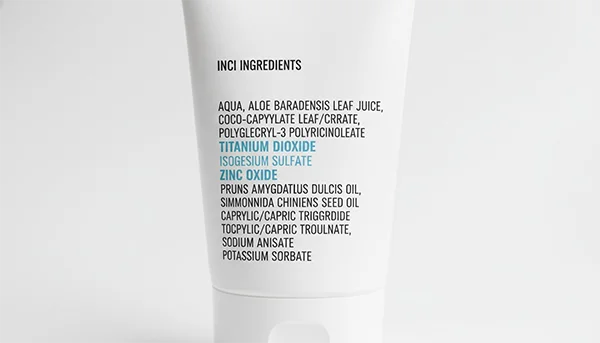
How to Read a Label: What to Look for and What to Avoid
The INCI (ingredients list) of a sunscreen contains a lot of useful information. Here's what to look for specifically.
Physical filters to be preferred for younger children
Titanium Dioxide and Zinc Oxide are the two main mineral filters. Both remain on the stratum corneum without penetrating deeper tissues. They are photostable, do not react with other ingredients, and are considered among the safest for pediatric skin. The "coated" version reduces the white effect typical of these minerals and improves tolerability.
Substances to avoid in children
According to the SIP and the FDA, the following substances warrant attention in formulas intended for young children: Oxybenzone (Benzophenone-3), Avobenzone (Butyl Methoxydibenzoylmethane), Octocrylene, and Ecamsule. They are not banned in Europe, but several regulatory bodies advise against their use in children due to skin absorption and concerns about their endocrine disrupting properties.
Perfumes and preservatives
For children with sensitive or atopic skin, a formula without fragrances and preservatives such as parabens and formaldehyde releasers is preferable. These substances increase the risk of sensitization and contact dermatitis.
Useful soothing active ingredients
A good sunscreen for sensitive skin may contain active ingredients that reduce UV inflammation: Ectoin, bisabolol, chamomile and calendula extracts, and allantoin. These aren't mandatory, but they improve tolerability, especially on reactive skin.
Can adult sunscreen be used on children?
This is one of the most frequently asked questions. The answer depends on the specific formula, not the product category.
An adult sunscreen can be used on children aged 3 and over if it meets these criteria:
- contains physical filters (TiO₂, ZnO) as main filters
- Does not contain substances reported by the FDA (Oxybenzone, Avobenzone, Octocrylene, Ecamsule)
- It is free of perfumes and essential oils
- has SPF 50 or 50+
Not all adult formulas meet these criteria. Before using a product not specifically tested for pediatric use, it's always a good idea to read the full INCI list and, if in doubt, consult your pediatrician.
For children under 6, unless medically indicated, it's best to use products containing only non-nano physical filters. Between 6 and 12 years old, the options expand, but the precautionary principle remains valid: the fewer absorbable chemical ingredients, the better.
Skin Types and Protection: Not All Children Are the Same
Skin phototype determines a child's natural defense against UV rays. Children with very pale skin, red or blond hair, and light-colored eyes (phototypes I and II) have reduced melanin production and burn easily even with brief exposure. Protection is even more critical for these children.
Children with darker phototypes (III and IV) have greater natural protection, but this does not mean they can do without sunscreen: deep UV damage, linked to UVA-I and UVA-II rays, occurs even without visible redness.
What to do in case of sunburn
If your child develops sunburn, the first priority is to get him or her into the shade and hydrate their skin with plenty of cool water. Further treatment depends on the severity. A complete guide on how to treat sunburn is available on the Melicor blog.
In children with darker or blemish-prone skin, sunburn increases the risk of post-inflammatory hyperpigmentation, a phenomenon explained in detail in the article on post-laser and post-sun hyperpigmentation.
Frequently Asked Questions
From what age can you use sunscreen?
Sunscreen is not recommended for children under 6 months: the skin is too permeable. Between 6 months and 3 years, only physical sunscreens with SPF 50+ are used. After 3 years, you can broaden your options, always checking that the formula does not contain substances listed by the FDA.
SPF 30 or SPF 50 for kids?
The SIP recommends SPF 50+ for young children. For older children with dark or already tanned skin, SPF 30+ may be sufficient. For fair skin (skin types I and II) or prolonged exposure, SPF 50 is always the more prudent choice.
Is it true that sunscreen blocks vitamin D?
The exposure required to synthesize vitamin D is approximately 15-30 minutes per day, at off-peak hours. Using sunscreen partially reduces synthesis, but does not eliminate it. The benefits of protection from UV damage far outweigh this effect. In cases of documented vitamin D deficiency, your pediatrician may consider oral supplementation.
Should I reapply the cream after just a 10-minute bath?
Yes. Even water-resistant products lose their effectiveness with water and drying. Toweling removes about 80% of the applied cream. Always reapply after swimming, regardless of duration.
Can the same sunscreen be used for adults and children?
It depends on the formula. An adult cream with non-nano physical sunscreens, fragrance-free, and free from FDA-recognized substances can be used on children 3 years and older. For younger children, a product with only physical sunscreens and specifically tested for pediatric use is preferable.
Bibliographic references
- Dennis LK et al. Sunburns and risk of cutaneous melanoma, does age matter: a comprehensive meta-analysis. Ann Epidemiol. 2008;18(8):614-627.
- Liu X et al. Childhood sunburn and risk of melanoma and non-melanoma skin cancer: a Mendelian randomization study. Environ Sci Pollut Res. 2023;31(1):1416-1427.
- Bäckvall H et al. Lifetime sunburn trajectories and associated risks of cutaneous melanoma and squamous cell carcinoma. JAMA Dermatol. 2022;158(11):1298-1306.
- Norval M, Halliday GM. The consequences of UV-induced immunosuppression for human health. Photochem Photobiol. 2011;87(5):965-977.
- Hart PH et al. Modulation of the immune system by UV radiation: more than just the effects of vitamin D? Nat Rev Immunol. 2011;11(9):584-596.
- Antille C et al. The mechanisms and consequences of ultraviolet-induced immunosuppression. Prog Biophys Mol Biol. 2006;92(1):6-13.
- Società Italiana di Pediatria. Creme solari, come proteggere i bambini nel modo corretto. 2022.
- U.S. Food & Drug Administration. Sunscreen: How to Help Protect Your Skin from the Sun. 2023.