
The fractional CO₂ laser is currently one of the most effective tools for professional skin rejuvenation. Thanks to its ability to penetrate deeply, stimulating collagen production, it is used to reduce wrinkles, improve skin texture, fade acne scars, and correct signs of photoaging. However, it is an ablative procedure, with recovery time requiring time, attention, and a precise treatment protocol.
This article explains how fractional CO₂ laser treatment works at the skin level, what happens to the skin in the weeks following the session, and how to properly establish a treatment routine to promote healing and prevent complications. Those experiencing this procedure for the first time will find the information they need here to be prepared.
What is fractional CO₂ laser and how does it work on the skin?
The CO₂ laser emits radiation at a wavelength of 10,600 nm, which is highly absorbed by the water in cells. When the beam reaches the skin, the water contained in the cells rapidly turns to vapor, causing the affected tissue to vaporize. This process is called ablation.
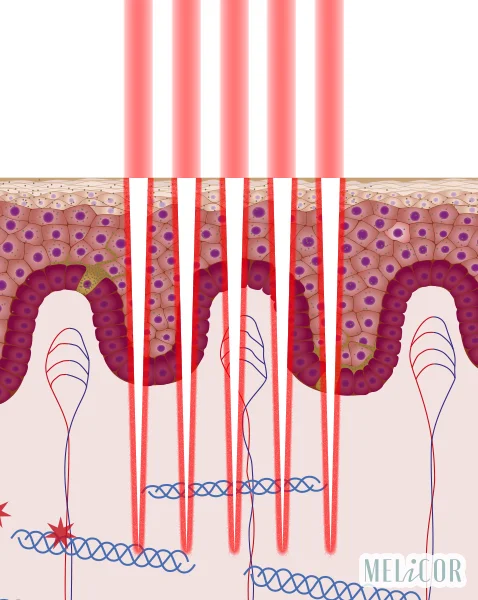 In the fractional version, the laser beam does not treat the entire skin surface uniformly. Instead, it is divided into thousands of microcolumns of ablation (called microscopic treatment zones), each of which removes a limited area of epidermis and superficial dermis. Between each microcolumn, areas of intact, untreated skin remain.
These healthy areas act as a cellular reservoir. Keratinocytes present in intact skin migrate to the ablated areas, accelerating re-epithelialization. This is why recovery from fractional laser is significantly faster than with non-fractional CO₂ lasers, where the entire surface is treated and repair must occur from the edges of the treated area.
The thermal effect generated around the microcolumns stimulates the production of new collagen and elastic fibers in the dermis. This process, called neocollagenogenesis, continues for weeks and months after the session and is the mechanism underlying the skin rejuvenation observed over time.
To better understand the distinction between ablative and non-ablative lasers, and why this affects the type of recovery expected, you can read the in-depth article Ablative and Non-Ablative Lasers: Differences, Recovery, and Skin Care.
Who is fractional CO₂ laser suitable for?
The fractional CO₂ laser is indicated for a wide range of skin conditions related to aging and UV damage. Common applications include: superficial and medium-thickness wrinkles, loss of skin firmness, enlarged pores, uneven texture, moderate acne scars, superficial discolorations, and signs of diffuse photoaging.
In terms of skin type, optimal candidates belong to skin phototypes I, II, and III according to the Fitzpatrick scale. In lighter skin types, melanin is less reactive to the inflammatory stimulus produced by the procedure, reducing the risk of post-inflammatory hyperpigmentation (PIH). In skin types III and IV, the risk increases and requires a careful evaluation, a targeted pre-treatment protocol, and rigorous post-laser care.
Some conditions represent relative or absolute contraindications: active skin infections in the treatment area, a tendency to form hypertrophic scars or keloids, recent use of isotretinoin (an interval of at least six months is generally recommended), and pregnancy. In individuals with a tendency toward abnormal scarring and multiple risk factors for PIH, the physician may prefer the Er:YAG erbium laser, which offers a more favorable safety profile in these cases thanks to more superficial ablation and less collateral thermal damage.
What to Expect: The Stages of Recovery
The recovery phase after fractional CO₂ laser treatment is divided into predictable stages. Knowing them in advance allows you to correctly interpret your skin's reactions, avoid unnecessary worry about what is normal, and instead recognize the signs that require attention.
Days 1–3: The acute phase
In the first hours after the session, the skin appears red, swollen, and feels intensely hot, similar to a severe sunburn. Edema, especially around the eyes, may be noticeable early the following morning. A clear, serous exudate may appear, which dries to form a thin film on the treated area. These reactions are part of the normal inflammatory response and indicate that the healing process has begun.
During this phase, it's essential to avoid any aggressive products on the skin, avoid rubbing, and avoid applying pressure. The burning sensation tends to subside over the first 24–48 hours. Signs that should prompt you to contact your doctor include: purulent or foul-smelling exudate, erythema extending beyond the treated area, fever, and disproportionate or asymmetrical pain.
Days 4–7: Desquamation and re-epithelialization
Around the fourth day, flaking begins, representing the detachment of the treated microcolumns. The skin appears dry, and microcrusts form in the areas where the ablation was most intense. Tightness and itching are common and can be bothersome.
At this stage, it's essential not to scratch, apply any type of mechanical peel, or try to remove the scabs. Forceful removal disrupts cell migration and can leave scars. The skin must be allowed to peel at its own natural rate. A suitable repair cream helps maintain the necessary level of hydration to make this process more comfortable and less risky.
Weeks 2–4: Re-epithelialization and maturation
By the end of the first week, re-epithelialization is largely complete: the skin surface is covered by a new layer of epidermis. However, the skin remains visibly red, pink, and particularly sensitive. The skin barrier has not yet regained its full functionality, transepidermal water loss (TEWL) is still elevated, and sensitivity to UV radiation is at its peak.
This phase is critical for preventing hyperpigmentation. The neoepidermis, rich in actively dividing cells, reacts intensely to unprotected sun exposure. This is the period during which adequate sun protection is not simply recommended but physiologically necessary. Residual erythema tends to progressively reduce over the first month, while collagen formation continues in the dermis for the next three to six months.
Why is it better to have CO₂ laser treatment in autumn or winter?
Fractional CO₂ laser treatment can be performed year-round. However, the autumn and winter months offer more favorable conditions for recovery due to the intensity and duration of sun exposure.
During the summer, UV radiation is higher, the days are longer, and daily behavior often involves greater sun exposure, even involuntary. For skin in the first weeks of post-laser recovery, even brief, unintentional exposure can be enough to trigger a melanocytic response and promote the appearance of dark spots.
This doesn't mean that CO₂ laser treatment is contraindicated during the summer months. With a high SPF mineral sunscreen, the use of protective clothing, observing the hours of lowest radiation exposure, and maximum compliance with the treatment protocol, the risk of hyperpigmentation can be minimized even in the warmer months. The difference lies in the safety margin: in autumn and winter, it is wider, and the patient needs to make less effort to keep their skin protected during healing.
Post-CO₂ laser care protocol
The first few weeks after fractional CO₂ laser surgery are the phase in which the treatment routine has the greatest impact on the outcome. A well-designed protocol reduces the risk of complications, shortens visual recovery time, and contributes to the quality of the final result.
Step 1: Gentle cleansing
In the first few hours following the session, the doctor will define the immediate protocol, which may include the application of gauze soaked in saline solution to keep the treated area moist. In the following days, when you begin home cleansing, it is essential to use a cleanser free of harsh surfactants, fragrances, and alcohol. Conventional cleansers, even those formulated for sensitive skin, can be too harsh for a compromised skin barrier at this stage.
An enzymatic cleanser with a physiological pH, based on soothing plant extracts, respects the integrity of the new epidermis without altering the developing hydrolipidic film. The gentle cleansing gel Enzyclean meets these requirements: an enzymatic formula, free of sulfates and fragrances, suitable for even the most delicate phases of post-procedure recovery.
Step 2: Repairing and soothing cream
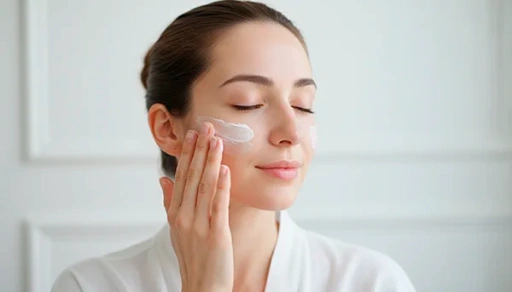
In the acute post-laser phase, the skin requires active support for barrier repair, inflammation control, and hydration without excessive occlusion. An appropriate repair cream must combine film-forming and humectant agents to maintain hydration, soothing and antioxidant ingredients to modulate the inflammatory response, and a texture that doesn't clog the follicles or impede skin respiration.
Epicalm Plus repair cream is specifically formulated for recovery after facial laser procedures such as photorejuvenation, fractional CO₂ laser, and vascular photocoagulation. Thanks to its lightweight, low-comedogenic base, it supports healing during acute phases without creating occlusion. The soothing and regenerating ingredients help the skin gradually regain its integrity.
Step 3: Mineral sunscreen
Sunscreen after CO₂ laser treatment isn't just one recommendation among many: it's a physiologically necessary measure. The neoepidermis that forms after the procedure is extremely sensitive to UV radiation, and even minimal unprotected exposure can trigger the melanocytic cascade underlying PIH.
Mineral sunscreens (titanium dioxide and zinc oxide) are preferable to chemical sunscreens in the first few weeks after the procedure because they remain on the skin's surface without penetrating, do not irritate the compromised barrier, and are photostable. To understand why these sunscreens are chosen in post-laser settings, it's helpful to consult the factsheets dedicated to titanium dioxide and zinc oxide.
Sunscreen can be applied as soon as re-epithelialization allows, generally around the fifth to seventh day, as directed by your doctor. The SPF 50 sunscreen for sensitive skin and SPF 30 mineral sunscreen are formulated with exclusively mineral filters, are fragrance-free, and contain no potentially irritating ingredients, making them suitable even during the post-laser recovery phase.
How to prevent post-laser pigmentation (PIH)
Post-inflammatory hyperpigmentation is one of the most common complications after fractional CO₂ laser treatment, particularly in skin types III–VI. When the skin is subjected to significant inflammatory stimulation, dermal melanocytes can respond by increasing melanin production, which deposits irregularly in the months following treatment.
The risk of PIH depends on several variables: the patient's skin type, the intensity and depth of the laser treatment, post-procedure sunscreen compliance, and individual predisposition. In darker skin types and in patients with a history of post-inflammatory spots, an active preventive approach should be considered.
In addition to sunscreen, an essential measure in any case, targeted depigmenting agents can be introduced as soon as re-epithelialization is complete, generally in the third or fourth week. Ingredients such astranexamic acid and niacinamide act on different mechanisms of melanogenesis, reducing pigment transmission to keratinocytes and modulating the inflammatory response. Lumicor anti-hyperpigmentation cream combines these active ingredients in a formula designed for the prevention and treatment of PIH in the post-laser setting.
For a complete overview of the mechanisms, timing, and prevention protocol, a dedicated guide is available: how to prevent blemishes after CO₂ laser treatment.
Frequently Asked Questions about Fractional CO₂ Laser
How many fractional CO₂ laser sessions are needed?
The number of sessions depends on the indication being treated and the intensity of the protocol used. For skin rejuvenation and superficial wrinkles, significant results are often achieved with a single session using more aggressive parameters. For acne scars or less intense treatments, two to four sessions may be recommended, spaced at least six to eight weeks apart to allow for complete healing and collagen maturation.
How long does the redness last after fractional CO₂ laser treatment?
The intense erythema of the initial few days gradually decreases over the first week. Residual redness, of varying intensity, may persist for two to six weeks after the session, depending on the depth of treatment and the patient's skin type. Visual recovery is more rapid with low-intensity treatments, while with more aggressive treatments, erythema may persist for up to four to six weeks.
When can I wear makeup after CO₂ laser?
Makeup application should wait until the skin has completely re-epithelialized, which generally occurs by the end of the first week. Before that point, cosmetic products may interfere with cell migration and increase the risk of irritation. Your doctor will confirm when your skin is ready to wear makeup again by assessing the state of re-epithelialization.
Can I have fractional CO₂ laser treatment in the summer?
The procedure is technically feasible in any season, but recovery in the summer requires a higher level of attention and compliance. More intense UV radiation and the greater difficulty in avoiding sun exposure increase the risk of post-inflammatory hyperpigmentation. With rigorous sun protection and appropriate behavior, the treatment can also be performed in warm weather, but the fall and winter months offer more favorable recovery conditions.
When can I expose my face to the sun after CO₂ laser treatment?
Direct sun exposure should be avoided for at least four to six weeks after the procedure. Use of a high SPF sunscreen with mineral filters should be continued throughout recovery and, ideally, throughout the summer season following treatment. Even after visual recovery, the skin remains more sensitive to UV radiation for several months.
Is fractional CO₂ laser painful?
Before the session, a topical anesthetic cream is applied for approximately 30–60 minutes, which significantly reduces discomfort during the procedure. Most patients describe the sensation as intense heat or tingling. In the hours following, the skin may burn, similar to a sunburn. The discomfort generally subsides within 24–48 hours.
The Melicor kit for post-CO₂ laser
For those seeking a structured treatment protocol for recovery after fractional CO₂ laser, the Post-CO₂ Laser Facial Kit contains three complementary products that provide everything you need for the first few weeks: gentle cleansing, skin barrier repair, and mineral sunscreen. This step-by-step approach is designed to simplify your routine on the days when your skin needs the most care.
This article is for informational purposes only and does not replace medical advice. Each laser treatment should be evaluated and customized by a specialized physician based on individual skin characteristics.