
The doctor said both options are possible: CO₂ laser or erbium laser. The expected results seem similar, but the recovery isn't. Before choosing, it's worth understanding the real differences between the two methods, who benefits more from one or the other, and how to protect your skin in the weeks following treatment.
How the two lasers work: a comparison of the mechanism
Both are ablative lasers, meaning they work by removing superficial layers of the skin to stimulate regeneration. The difference lies in the depth and heat they produce.
The CO₂ laser emits light at a wavelength of 10,600 nm, which is highly absorbed by the water contained in cells. This produces precise vaporization of the tissue, leaving a significant amount of residual heat in the surrounding tissue. It is precisely this heat that stimulates collagen production deep within the skin, but at the same time requires a longer recovery period.
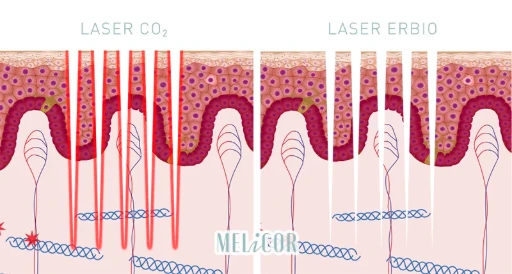
The erbium Er:YAG laser emits at 2,940 nm, a wavelength that coincides with the peak absorption of water: the result is highly precise ablation with minimal heat loss. It removes tissue in a controlled manner without excessively heating adjacent structures. Recovery is shorter precisely because the inflammatory response is less intense.
In short: CO₂ works deeply and produces a greater regenerative stimulus, but also a greater tissue response. Erbium works more selectively, with limited thermal impact and generally faster recovery.
What problems is each laser used for?
The two methods partially overlap in their indications, but each has an elective profile.
The fractional CO₂ laser is the preferred choice for medium to deep wrinkles, acne scars with significant dermal components, and pronounced photoaging with loss of tone and redefinition of the contour. It acts on deeper layers and produces more intense collagen stimulation, with noticeable results even in a single session.
The erbium Er:YAG laser is best suited for superficial and medium-thickness wrinkles, irregular texture, blemishes, and superficial photodamage, where deep ablation is not necessary. It is also indicated in situations where the risk of post-inflammatory hyperpigmentation requires caution: the lower thermal dispersion reduces the inflammatory stimulus, lowering the likelihood of PIH compared to CO₂. Similarly, in subjects predisposed to hypertrophic scarring, the reduced thermal damage of erbium represents a significant clinical advantage. For the same reasons, erbium is often preferred for particularly delicate facial areas such as the eye contour and neck.
Where the two methods overlap: general skin rejuvenation, improvement of texture and even tone, treatment of areas with moderate photodamage.
Who is it suitable for: skin types and contraindications
The choice between the two methods also depends on the phototype, because the risk of post-inflammatory hyperpigmentation is not the same for everyone.
The CO₂ laser is mainly indicated for phototypes I, II and III according to the Fitzpatrick classification. In skin types IV and V, the risk of PIH increases significantly: melanocytes, already more active, respond to inflammation by producing melanin that can leave persistent dark spots. Skin type VI generally represents a relative contraindication to the ablative CO₂ laser.
The Er:YAG erbium laser is better tolerated by skin types III and IV, thanks to its reduced thermal component. However, for skin types V and VI, a careful medical evaluation is still necessary, and PIH prevention must be planned before treatment.
Contraindications common to both methods: tanned skin at the time of treatment, recent use of oral isotretinoin, active skin infections, known tendency to form keloids.
Recovery: How Long It Takes and What to Expect
This is the most concrete difference between the two methods, the one that affects treatment planning and the final choice of many patients.
During the first three days, the CO₂ laser produces an intense inflammatory response: marked erythema, edema, a burning sensation, and possible serous exudation. The skin appears red and swollen, and the level of discomfort is significant. During this phase, it is essential that nothing disrupts the skin barrier being rebuilt: no harsh cleansers, no irritating active ingredients, and no sun exposure. A rich restorative emollient, like a post-laser repair cream, helps protect the tissue while regeneration begins.
With the erbium laser, the acute phase is more limited: redness is present, but less intense; swelling is generally milder and resolves more quickly. Within the first 48 hours, the skin begins to progress towards the desquamation phase.
Between the fourth and seventh days, CO₂ enters the desquamation phase: the skin peels off in flakes, itching can be bothersome, and the skin barrier is still fragile. Erbium, during this same period, has already largely completed the superficial re-epithelialization: the skin is still sensitive, but more stable.
During weeks two and four, those who received CO₂ still notice a pinkish rash that gradually fades, and the skin remains reactive to external stimuli, including the sun. With erbium, most patients return to a normal routine by the end of the second week, while maintaining sun protection.
In both cases, recovery is not just a matter of time: it is the quality of care in the first few weeks that determines the final aesthetic result and the prevention of complications.
Risk of post-laser hair loss (PIH): who should be aware of this?
PIH, or post-inflammatory hyperpigmentation, is the most common complication after ablative laser treatment. It's not an inevitable side effect, but it's a real risk that depends on three factors: the chosen procedure, the patient's skin type, and post-treatment management.
The CO₂ laser produces more intense tissue inflammation, which in medium-dark skin types can result in overstimulation of melanocytes. This results in the appearance of hyperpigmented spots in the following weeks, often in the same treated areas. The risk isn't limited to skin types IV–VI: even skin type IIIs with unprotected sun exposure during recovery can develop PIH.
With the erbium laser, the risk is lower due to the reduced inflammatory response, but it is not completely absent. Predisposed skin types, accidental sun exposure, or overly aggressive cleansing can still trigger the mechanism.
Prevention begins before treatment and continues in the weeks following. Those with at-risk skin types can benefit from a specific protocol with ingredients that modulate melanin production. A product formulated with tranexamic acid and new-generation depigmenting active ingredients, such as Lumicor, is a preventive tool to be evaluated with your doctor during the treatment planning phase. To learn more about pigmentation after laser, see the article on post-inflammatory laser hyperpigmentation for a detailed guide.
The treatment protocol: the same for both, with some differences
After both CO₂ and erbium, the protocol is divided into three fundamental steps. The intensity and duration of the individual phases vary, but not the underlying logic.
Gentle cleansing: After an ablative treatment, any cleanser not formulated for sensitive and reactive skin risks compromising the still-fragile skin barrier. A product with a physiological pH, free of harsh surfactants, is needed to remove impurities without altering the replenishing hydrolipidic film. A gentle cleansing gel for sensitive skin does this job without irritating.
Barrier repair and protection: A post-procedure repair cream must meet three simultaneous needs: calm inflammation, support cell regeneration, and maintain hydration without occluding the tissue during the re-epithelialization phase. After CO₂, the more intense acute phase requires a product with prolonged soothing action. After erbium, the skin requires the same support but for a shorter period of time. A repair cream formulated specifically for post-laser treatment meets this need for both procedures.
Sunscreen: Not Optional. After any ablative treatment, the newly formed skin lacks the protective stratum corneum that normally filters UV radiation. Sun exposure, even indirect exposure, not only slows healing but is the primary trigger for PIH. Sunscreen with mineral filters is recommended in the first few weeks: titanium dioxide and zinc oxide act by reflection without penetrating the tissue, reducing the risk of irritation. A mineral sunscreen with SPF 50 for sensitive skin for sensitive skin is recommended from the day your skin allows application. As soon as the risk of sunburn decreases, consider switching to a mineral sunscreen with SPF 30 for your daily routine.
Choosing Between CO₂ and Erbium: A Practical Guide
There's no universal answer. The choice depends on four variables that the doctor will evaluate with the patient.
The problem to be treated. Deep wrinkles, significant dermal scars, and pronounced photoaging respond best to CO₂. Uneven texture, superficial wrinkles, and epidermal photodamage are the preferred treatment for erbium.
Skin type. Skin types I–III tolerate both methods well. Skin types III–IV find erbium to be a more favorable risk profile. Skin types V–VI require individual evaluation and specific PIH prevention protocols.
Acceptable downtime. Those who can afford 10–14 days of recovery can access the most profound results from CO₂. Those with 5–7 days of recovery should opt for erbium.
Predisposition to scarring. In cases where there is a tendency to form hypertrophic or keloid scars, even in areas distant from the ones being treated, erbium offers a more favorable safety profile due to its lower thermal damage.
In both cases, the articles dedicated to the fractional CO₂ laser and the Er:YAG erbium laser delve into the specifics of each method, day-to-day recovery, and the detailed treatment protocol.
Frequently Asked Questions
What is the shortest recovery between CO₂ and erbium?
The Er:YAG erbium laser generally has a quicker recovery: most patients return to their normal routine within 5–7 days. After the fractional CO₂ laser, full recovery takes 10–14 days, with residual erythema that may persist for several weeks.
Can I have the erbium laser if I have dark skin (phototype IV or V)?
Erbium is generally considered safer than CO₂ for medium-dark skin types due to its lower thermal component. However, PIH risk assessment is individual and must be performed by a physician. A preventative protocol with depigmenting ingredients may be recommended in the weeks before and after treatment.
How long should I avoid the sun after laser?
After CO₂ laser treatment, rigorous sun protection is required for at least 4–6 weeks, with direct exposure avoided for the first two weeks. After erbium laser treatment, the period is generally shorter, but daily sunscreen with a high SPF remains essential for at least 3–4 weeks to prevent PIH.
Is the erbium laser less effective than CO₂?
It depends on the objective. For deep wrinkles and dermal scars, CO₂ offers more pronounced results. For texture, superficial wrinkles, and epidermal photodamage, erbium produces equivalent results with a shorter recovery time. It's not a question of absolute efficacy, but of the method's suitability for the specific problem.
What should I apply to my skin in the first few days after laser treatment?
In the first few days, three things are essential: a gentle cleanser with a physiological pH, a repairing cream formulated for post-laser use, and avoid sun exposure. Avoid perfumes, alcohol, exfoliants, and any potentially irritating active ingredients. Mineral sunscreen should be added to your routine as soon as your skin allows it.
Can a stain appear after the erbium laser?
Yes, although the risk is lower than with CO₂. PIH can occur in those with predisposed skin types, in those who expose themselves to the sun during recovery, or in those who use products not suitable for the post-procedural phase. Prevention, planned before treatment, significantly reduces this risk.
The Melicor kit for post-ablative laser
To simplify the care protocol in the weeks following an ablative treatment, the CO₂ post-laser kit combines three essential steps: gentle cleansing, barrier repair, and mineral sunscreen. This protocol is already calibrated for post-procedure recovery and can be applied after both CO₂ and erbium treatments.