
When it comes to sunscreen, the difference between a tinted and a non-tinted formula seems almost aesthetic: a little more coverage, an even tan. In reality, the distinction is pharmacologically relevant, especially if you're dealing with post-inflammatory hyperpigmentation or melasma.
A tinted SPF isn't simply an SPF with added pigment. It contains iron oxides that block high-energy visible light, a range of the solar spectrum that traditional UV filters don't address. And visible light, as we'll see, is an active trigger of melanogenesis.
What's the real difference between tinted and non-tinted SPF
Conventional sunscreen, tinted or not, is designed to block ultraviolet radiation: UVB (280–315 nm) and UVA (315–400 nm). Mineral filters such as Titanium Dioxide and Zinc Oxide work primarily in this range. Visible radiation coverage (400–700 nm) is minimal or nonexistent, regardless of the SPF value indicated on the label.
This is where the colored formula comes into play. Iron Oxides, naturally opaque inorganic pigments, absorb and reflect light in the visible range. They aren't just added to cover imperfections: they perform a specific photoprotective function that a non-tinted SPF cannot provide.
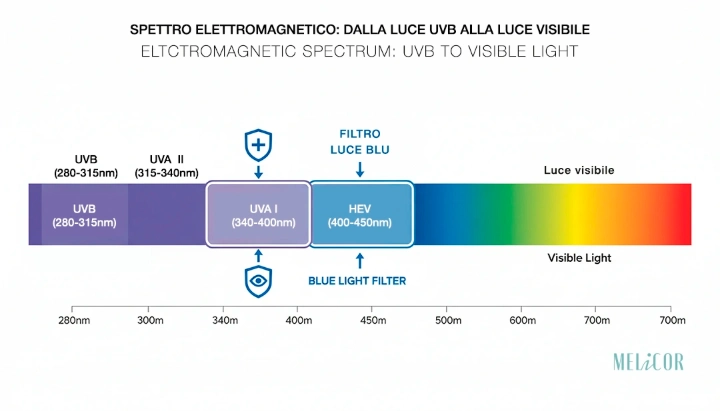
The practical result: two products with the same SPF number can have a very different protection profile if one contains iron oxides and the other does not.
Why visible light worsens PIH and melasma
Until a few years ago, visible light was considered essentially harmless to the skin. Studies over the past decade have changed this perspective, especially regarding the high-energy portion of the visible spectrum: blue-violet light, between 400 and 450 nm, also known as HEV (High Energy Visible light).
HEV light penetrates the superficial dermis and stimulates melanin production through mechanisms distinct from UV. Specifically, it activates the OPSIN3 receptor in melanocytes and generates oxidative stress through the production of reactive oxygen species (ROS). In individuals whose melanocytes are already sensitized by inflammation, laser treatments, or genetic predisposition, this stimulus can result in reactivation of hyperpigmentation even in the absence of direct sun exposure.
A study by Mahmoud et al. (2010) demonstrated that in skin type IV–VI, visible light alone, without a UV component, was sufficient to induce persistent hyperpigmentation. Subsequent research by Castanedo-Cazares and Kohli's group confirmed that formulas with iron oxides significantly reduce melasma recurrence compared to pigment-free SPFs, even with the same UV protection factor.
This is particularly relevant for those who use sunscreen indoors or in environments with strong artificial lighting: digital screens, LED lights, and office lighting emit light in the HEV range, and without iron oxides, that protection does not exist.
Iron oxides: the filter that protects from visible light
Iron Oxides occur in nature in three main forms, corresponding to the colors red, yellow, and black. In cosmetic formulations, they are combined to achieve the desired shade and, simultaneously, to cover the entire range of high-energy visible light (400–700 nm).
Their mechanism of action is physical: they absorb and reflect light without interacting with biological tissues. They are chemically stable, well tolerated even by reactive skin, and non-comedogenic. They do not penetrate the stratum corneum and do not cause sensitization.
From a clinical perspective, the concentration of iron oxides in the formula is crucial. A product with traces of pigment added solely for aesthetic reasons won't offer the same protection as a formula containing iron oxides at a photoprotective concentration. This is a difficult element to read on the label, but it distinguishes professional formulas from purely cosmetic ones.
DHHB (Uvinul A Plus): the UVA I protection that completes the picture
Even in the ultraviolet range, there are areas of vulnerability that mineral filters alone do not optimally cover. UVA is divided into two subregions: UVA2 (315–340 nm) and UVA I1 (340–400 nm). Mineral filters such as titanium dioxide and zinc oxide are effective against UVA2 and UVB, but their performance progressively decreases in the UVA I band, the longest and most penetrating.
UVA I reaches the deep dermis, contributes to the photooxidation of pre-existing melanin, and stimulates the production of new pigments through oxidative pathways. It is primarily responsible for the so-called instant, persistent tan, but also for the destabilization of existing dark spots, making it difficult to maintain the results achieved with depigmenting products.
DHHB (Uvinul A Plus) is a lipophilic organic filter with an absorption peak centered on UVA I (355–380 nm). Its molecular structure gives it high photostability: unlike some previous-generation UV filters, it does not degrade with prolonged exposure and does not generate reactive byproducts. This characteristic makes it particularly suitable for daily use formulations, where long-term stability is essential to ensure constant protection.
In Melicor SPF 50 sunscreens and LSF 30, DHHB is combined with mineral filters to provide targeted coverage of the UVA I range, creating continuous spectrum protection: UVB, UVA II, and UVA I. In tinted versions, iron oxides further extend this coverage up to visible light (HEV).
The result is a formula designed not only to prevent erythema, but to interrupt the main mechanisms stimulating melanogenesis across the entire relevant solar spectrum.
Which SPF to choose based on skin type and condition
The choice between tinted and non-tinted SPF is never just a matter of aesthetics. It depends on your skin type, current skin condition, and the context in which you're using it.
Skin types I–II without active hyperpigmentation: Standard UV protection is sufficient to prevent erythema and photoaging. A non-tinted SPF with DHHB covers UVA I and provides complete broad-spectrum protection. The tinted version remains a good choice if you prefer an even effect, but it is not strictly necessary from a clinical standpoint.
Phototypes III–IV with PIH or melasma. Here, visible light becomes an active factor in recurrence. Tinted SPF with iron oxides is highly recommended as daily protection, even in the absence of direct sun exposure. The combination of DHHB + iron oxides + mineral filters guarantees full-spectrum coverage: UVB, UVA II, UVA I, and visible light. Consult the guide on the difference between PIH and melasma for a more precise interpretation of your case.
Phototypes V–VI or skin with persistent melasma: Protection from visible light is as important as UV protection. Tinted SPF is the first-line choice. In these cases, the choice of depigmenting product to combine is also important: a product like Lumicor, based on tranexamic acid and cetyl tranexamate mesylate, works on melanogenesis from the inside while the SPF blocks it from the outside.
Post-laser or post-procedure. Following fractional ablative therapy, the skin is in a state of active inflammation, and melanocytes are particularly reactive (see more details on preventing hyperpigmentation after CO₂ laser treatment). A tinted sunscreen with iron oxides should be applied immediately after the skin barrier has been restored, before direct sun exposure. The protocol for preventing post-laser inflammatory hyperpigmentation includes the use of sunscreen as a key component.
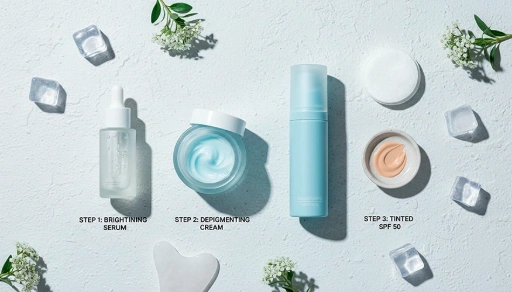
How to incorporate tinted SPF into your anti-blemish routine
Sunscreen, tinted or not, is the last step in your morning routine, applied after moisturizer and depigmenting treatments. Some practical tips:
Quantity. To achieve the SPF declared on the label, you need to apply approximately 2 mg per cm² of skin surface. In practice, this corresponds to about half a teaspoon for an adult face. A smaller amount will proportionally reduce its effectiveness.
Reapplication. In case of direct sun exposure, reapplication every two hours is necessary regardless of the formula. Indoors, morning application is sufficient if you don't sweat or wash your face.
Combination with depigmenting products. Lumicor should be applied in the evening or as the penultimate step in the morning, before SPF. The combination of depigmenting treatment + full-spectrum protection is more effective than either approach used alone.
Shade selection. Melicor tinted versions are available in shades suitable for fair to medium skin. If coverage isn't sufficient for your skin type, you can combine the tinted version with the untinted version applied in a double layer, taking advantage of the UVA I protection of DHHB present in both.
For daily protection on sensitive or post-procedure skin, the Melicor line offers:
- SPF 50 face cream and SPF 50 tinted for maximum UV protection
- SPF 30 face cream and SPF 30 tinted for daily soothing use
- Lumicor as a depigmenting treatment to be combined with protection
To help you choose the most suitable mineral sunscreen, also consult the SPF and melasma guide.
Frequently Asked Questions
Does a tinted SPF really protect more from pigments?
Yes, but only if it contains iron oxides at a photoprotective concentration. Iron oxides block visible light (HEV) (400–700 nm), which conventional UV filters do not cover. This makes them particularly useful for PIH and melasma, where visible light is a documented trigger of melanogenesis.
Is DHHB safe for daily use?
DHHB (Uvinul A Plus) is a photostable organic UV filter, approved by the European Union and widely studied. It does not degrade with sun exposure and does not penetrate the stratum corneum in significant quantities. It is considered safe for daily use, even on sensitive skin.
Can I use a non-tinted SPF if I have melasma?
A non-tinted SPF with DHHB still offers effective protection against UVB, UVA II, and UVA I. However, in the presence of active melasma or phototypes III–VI, the visible light protection provided by iron oxides has an additional clinical value that the non-tinted version cannot offer.
Iron oxides can be irritating?
No. Iron oxides are inert, chemically stable, and non-allergenic inorganic pigments. They are among the best-tolerated cosmetic pigments, included in the INCI list of ingredients permitted without restrictions for use on the skin.
SPF 30 or SPF 50: Which to choose for blemish prevention?
SPF 50 is preferable for active melasma or after laser procedures, during the summer months, and for prolonged sun exposure. SPF 30 is suitable for daily use indoors or during low-sun seasons, when DHHB still provides optimal UVA I coverage.
BIBLIOGRAPHICAL REFERENCES
- Mahmoud BH, Ruvolo E, Hexsel CL, et al. Impact of long-wavelength UVA and visible light on melanocompetent skin. Journal of Investigative Dermatology. 2010;130(8):2092-2097.
- Castanedo-Cazares JP, Hernandez-Blanco D, Carlos-Ortega B, Fuentes-Ahumada C, Torres-Alvarez B. Near-visible light and UV photoprotection in the treatment of melasma: a double-blind randomized trial. Photodermatology, Photoimmunology & Photomedicine. 2014;30(1):35-42.
- Kohli I, Shafi R, Isedeh P, et al. The impact of iron oxides in zinc oxide-based sunscreens on UV-induced skin damage. Journal of the American Academy of Dermatology. 2018;78(4):706-712.
- Passeron T, Picardo M. Melasma, a photoageing disorder. Pigment Cell & Melanoma Research. 2018;31(4):461-465.
- Grether-Beck S, Marini A, Jaenicke T, Krutmann J. Photoprotection of human skin beyond ultraviolet radiation. Photodermatology, Photoimmunology & Photomedicine. 2014;30(2-3):167–174.
- Bernerd F, Passeron T, Castiel I, Marionnet C. The detrimental effects of ultraviolet, visible and infrared radiation on the skin and the protective effects of photoprotection. Antioxidants (Basel). 2022;11(8):1663.
- SCCS (Scientific Committee on Consumer Safety). Opinion on Diethylhexyl Butamido Triazone (DHHB). European Commission. 2021. SCCS/1624/21.