
You've probably heard of laser skin rejuvenation, but every time you try to understand it, you find yourself with more questions than ever before. Ablative, non-ablative, fractional, CO₂, erbium: the terminology piles up, and aesthetic doctors often don't have time to explain it all. Yet the difference between an ablative and non-ablative procedure isn't a technical detail: it varies in the type of result, the recovery time, the risks to the skin, and the necessary aftercare. Understanding it allows you to approach the treatment with realistic expectations and take proper care of your skin.
What does "ablative" mean: the skin that is removed
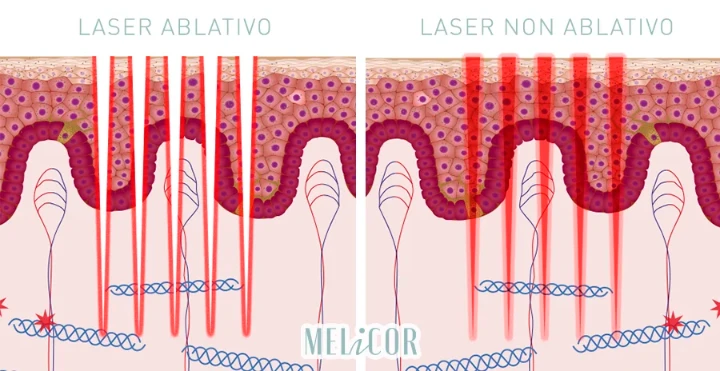
The term ablative comes from the Latin ablatio, meaning removal. In laser dermatology, it describes exactly what happens: the light beam physically removes the superficial layers of the skin, vaporizing the cells through intense, localized heat.
This process first affects the stratum corneum and the epidermis and, depending on the intensity and whether the treatment is fractionated or non-fractionated, can reach the superficial dermis. Controlled thermal destruction triggers a deep regenerative response: the skin produces new collagen, cells renew themselves, and surface irregularities are eliminated along with the removed layers.
The most common ablative lasers are the CO₂ laser (10,600 nm) and the erbium Er:YAG laser (2,940 nm). They operate at wavelengths that are effectively absorbed by intracellular water, resulting in rapid and precise vaporization of the target tissue. The difference between the two primarily concerns the depth of penetration and the amount of residual heat transmitted to surrounding tissue: CO₂ produces a more widespread thermal effect, while erbium is more selective and causes less collateral damage.
In their fractional form, ablative lasers do not treat the surface uniformly, but create thousands of microcolumns of ablation separated by intact areas. This approach significantly reduces recovery time compared to the non-fractional version, while maintaining significant efficacy.
What does "non-ablative" mean: stimulating without removing
Non-ablative lasers work in the opposite way: the skin's surface remains intact. The light energy penetrates the epidermis without destroying it and is deposited in the dermis, where it generates localized heat that stimulates collagen production and induces progressive tissue remodeling.
The epidermis is not removed or significantly damaged, which results in much shorter recovery times, often limited to a few hours of redness, and a lower risk profile.
Non-ablative devices include Nd:YAG lasers (1064 nm), fractional diode lasers, erbium glass systems (1550 nm), and thulium lasers. Each has specific indications and different penetration depths, but they all share the principle of acting on the dermis without ablaminating the epidermis.
IPL (Intense Pulsed Light) technically belongs to the category of non-ablative systems, but it is distinguished from lasers by one important characteristic: it does not emit a single, coherent wavelength, but rather a light spectrum that can be filtered to selectively target different targets, such as melanin pigment, vascular hemoglobin, and collagen. This selectivity makes it particularly versatile for treating blemishes, spider veins, and diffuse redness in a single session. To learn more about its use in skin rejuvenation, you can read our guide on facial photorejuvenation.
A third way: fractional hybrid lasers
Alongside the two main categories, there are systems that combine an ablative and a non-ablative component in a single session, applied simultaneously to the same area. The idea is simple: the non-ablative component stimulates the dermis deeply, while the ablative component treats the surface, achieving some of the effectiveness of an ablative laser with less downtime than a traditional ablative treatment.
This category is still relatively uncommon in Italy compared to other markets, but it is growing. For those considering this option, we will provide a separate in-depth analysis. In the meantime, the basic logic remains the same as described above: the more ablative the procedure, the more effective it is per session and the more care it requires during the recovery phase.
Ablative vs. Non-Ablative: Comparing the Differences
Ablative laser | Non-ablative laser | Fractional hybrid laser | |
|---|---|---|---|
| Mechanism | Removes superficial and deep layers of the skin | Stimulates the dermis without removing the epidermis | Combines ablative and non-ablative components in one session |
| Examples | CO₂, Er:YAG | Nd:YAG, fractional diode, erbium glass, IPL | Latest generation fractional hybrid systems |
| Effectiveness per session | High: visible results after 3-4 sessions | Moderate: progressive results | High: visible results after 1–2 sessions |
| Necessary sessions | 2-4 | 4-6 or more | 1-2 |
| Downtime | 5–14 days | 0–3 days | 0-3-5 days |
| PIH risk | Medium-high (phototypes III–VI) | Low-medium | Low |
| Pain/discomfort | High | Low | Moderate |
| Main indications | Deep wrinkles, scars, skin laxity | Mild discoloration, texture, tone, vascular spots | Wrinkles, sun-damaged skin, discoloration, improved skin texture, enlarged pores |
Recovery: What Really Changes
The most tangible difference between an ablative and a non-ablative laser is measured in recovery days and what happens to the skin in the hours and weeks following the procedure.
After an ablative laser
In the first 24–72 hours, the skin is red and swollen, and a serous exudate may form, a thin crust that serves to protect the tissue while it regenerates. Burning is present and can be intense in the first few hours; swelling around the eyes is common with facial treatments. This phase requires active care: the skin no longer has its natural protective barrier and must be protected from drying out, infection, and any aggressive stimuli.
Flaking begins between the fourth and seventh day: the crust gradually separates, revealing pink, hypersensitive skin. Itching is common and is a sign of ongoing regeneration. It's crucial not to remove the crusts manually: doing so significantly increases the risk of scarring and uneven pigmentation.
During weeks 2–4, the redness gradually fades. The new skin is still vulnerable to UV rays and mechanical friction. Routines gradually return to normal, but sunscreen remains mandatory for several months.
After a non-ablative laser
The immediate skin impact is much less severe. Redness lasts a few hours, rarely exceeding 24–48 hours, and no crusting or oozing occurs. Many people resume normal activities the day after the procedure. This doesn't mean the skin doesn't need care: the dermis has been subjected to thermal stress, and sunscreen remains a necessity, not an option.
Who is it suitable for: phototypes and objectives
The choice between an ablative and a non-ablative approach depends on two main factors: the desired result and the skin phototype.
Those with deep wrinkles, pronounced acne scars, or significant skin laxity achieve the most visible results with ablative lasers, which penetrate deeply and trigger an intense regenerative response. However, this effectiveness comes at a cost: the risk of complications, particularly the appearance of dark spots (post-inflammatory hyperpigmentation, PIH), increases in darker skin types, namely, skin types IV, V, and VI on the Fitzpatrick scale.
Those with a darker skin type, or those who want to improve texture, skin tone, and minor discolorations without undergoing extensive recovery, find non-ablative lasers a safer and equally effective solution in the medium to long term, provided they are willing to undergo multiple sessions and wait longer before seeing results.
This assessment is always the responsibility of a dermatologist or aesthetic doctor, who considers the skin type, specific indication, medical history, and patient expectations before recommending the most appropriate treatment.
How to care for your skin after laser treatment
Regardless of the type of laser procedure, post-treatment care follows three fundamental steps. The difference lies in the intensity and duration of the necessary care: after an ablative laser, the protocol is more rigorous and extends over several days; after a non-ablative treatment, it is simpler but still necessary.
Step 1: Gentle cleansing
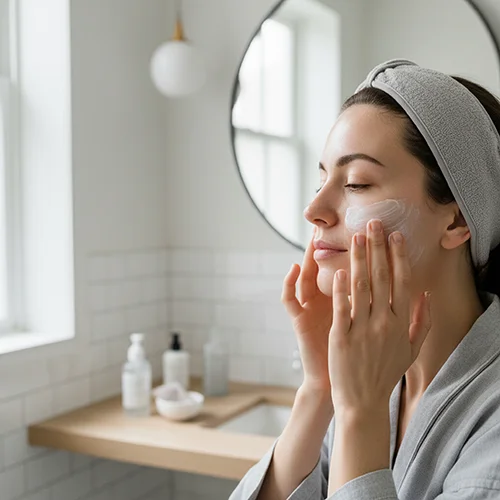
After a laser procedure, the skin barrier is temporarily compromised. Traditional cleansers, even those formulated for normal skin, contain surfactants and ingredients that are aggressive at this stage, further altering the skin's microbiome and slowing healing. A specific facial cleanser for sensitive and reactive skinis needed, with a gentle formula and physiological pH, that cleanses without stripping residual barrier lipids.
Step 2: Barrier Repair and Protection
A repair cream in the early post-laser phases has a specific function: to reduce the inflammatory response, support cell regeneration and prevent transepidermal water loss (TEWL) which slows healing.
After an ablative laser or intense photorejuvenation treatment, the ideal formulation is light, non-occlusive, and contains highly tolerable soothing ingredients, considering that skin at this stage reacts even to ingredients it normally tolerates perfectly. After non-ablative treatments with minimal downtime, a more traditional soothing formulation that calms redness and maintains hydration is sufficient.
Step 3: Sunscreen, not optional
After any laser procedure, the skin becomes photosensitized: melanin is temporarily hyperreactive, and exposure to UV rays, even briefly and even on cloudy days, can undermine the treatment results and trigger uneven pigmentation that is difficult to treat.
Sunscreen isn't just a comfort recommendation: it's an integral part of the treatment protocol. The preferred choice after laser treatment is mineral sunscreens (zinc oxide and titanium dioxide), which physically reflect light without being absorbed by damaged skin. You can find more information on the differences between UVA and UVB rays rays and why this distinction matters in post-laser protection.
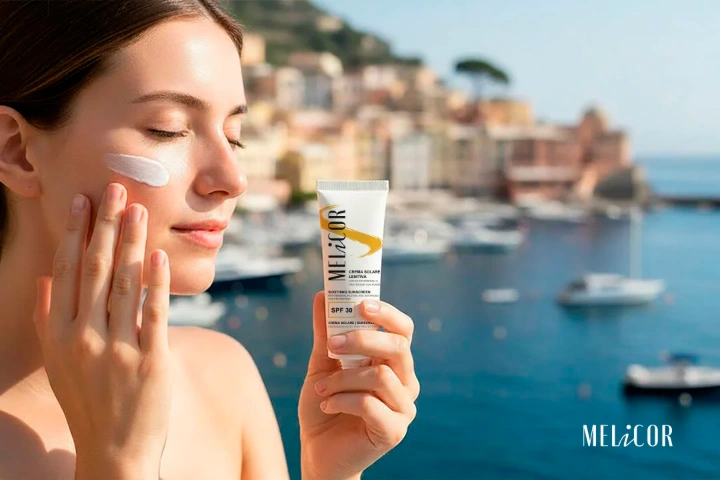
A mineral sunscreen with SPF 50 for sensitive skin is the ideal choice in the first few weeks after ablative treatment. For a non-ablative treatment with rapid recovery, a mineral SPF 30 with soothing ingredients is also appropriate for your daily routine afterward.
The risk of post-laser pigmentation
Post-inflammatory pigmentation (PIH) is one of the most common complications of laser treatments, often overlooked in pre-procedure consultations. It manifests as dark spots that appear in the weeks following treatment, in areas where inflammation has been most intense, and is caused by overproduction of melanin in response to skin damage.
The risk is higher in darker skin types, in people who expose themselves to the sun during recovery, and in those who do not follow an adequate post-procedure care protocol. Ablative lasers, by generating more intense inflammation, carry a higher risk of PIH than non-ablative treatments.
Prevention begins before the procedure and continues for weeks afterward: rigorous sun protection is the first line of defense. When your doctor deems it appropriate, a specific topical treatment may also be prescribed to inhibit melanin production in the weeks following the procedure. You can learn more about this topic in the article dedicated topost-laser hyperpigmentation, where you can also find information on Lumicor, the hydroquinone-free Melicor cream formulated for the prevention and treatment of PIH.
In summary: effectiveness vs. ease of recovery
The choice between ablative and non-ablative lasers is not a question of "which is better overall," but of which is best suited to your goal, skin type, and the time you have available for recovery.
Ablative lasers offer more dramatic results in fewer sessions, but require a longer recovery time (up to two weeks) and carry higher risks, especially for those with darker skin. They are the choice for serious indications: deep wrinkles, scars, or a significant reduction in skin laxity.
Non-ablative lasers have almost no impact on daily life (return to normal activities within a day or two) and have a much more favorable safety profile. The tradeoff is that results build over time, session after session, and require greater patience and a longer program.
In both cases, skin care during the recovery phase significantly determines the quality of the final result. It's not an accessory to the treatment: it's part of the treatment itself.
Frequently Asked Questions
Ablative or non-ablative laser: how do I choose?
The choice depends on the clinical indication (type of problem being treated), skin phototype, and the willingness to undergo a more or less lengthy recovery period. The ablative laser is indicated for significant issues that require in-depth treatment; the non-ablative laser is preferred when the aim is to gradually improve tone, texture, and minor discolorations with minimal downtime. The final decision always rests with the doctor, who evaluates individual suitability.
How many days of recovery after an ablative laser?
It depends on the type and intensity of treatment. In the fractionated version, the most common, active recovery generally lasts 5–7 days, during which the skin crusts and flakes. Residual redness may persist for 2–4 weeks. In the non-fractionated version, recovery times are significantly longer.
Is the non-ablative laser less effective?
Not in absolute terms: it's per single session. With an adequate number of treatments, the results are significant and long-lasting. The difference is that the process is more gradual: instead of one or two intensive sessions, four to six sessions are generally scheduled over the course of a few months.
When can I expose myself to the sun after laser?
Direct sun exposure should be avoided for at least 4–6 weeks after an ablative treatment, and adequate sun protection should always be used even after this phase. After a non-ablative treatment, the precautionary period is shorter, but daily sun protection remains necessary throughout the entire treatment cycle and beyond.
Can laser cause dark spots?
Yes, it's one of the most common complications, called post-inflammatory hyperpigmentation (PIH). The risk increases with darker skin types, those exposed to the sun during recovery, and those who don't follow an adequate treatment protocol. Prevention is possible and begins with rigorous sun protection.
How many sessions are needed on average?
For fractional ablative lasers, 1–3 sessions are typically scheduled, spaced 4–8 weeks apart. For non-ablative lasers, the typical schedule is 4–6 sessions, spaced more closely together, often every 3–4 weeks. Session times vary depending on the specific treatment and individual response.
The three-step post-laser protocol
For those who prefer to have everything they need ready, Melicor offers specific kits formulated for different procedures: the post-CO₂ laser kit i s designed for recovery after the most intense ablative procedures, while the post-photorejuvenation kit includes the three essential products for non-ablative procedures and IPL treatments.
This article is written for informational purposes only. The information contained herein does not replace the advice of a dermatologist or aesthetician.