
You've just completed a laser treatment to rejuvenate your skin or remove dark spots, but a few weeks later you notice new discoloration appearing? You're not alone: post-inflammatory hyperpigmentation (PIH) affects up to 75% of patients undergoing ablative procedures, especially those with Fitzpatrick skin types III-V.
In this guide, you'll discover why PIH develops, which procedures carry the highest risk, and most importantly, how to prevent and treat it effectively.
Why post‑laser hyperpigmentation occurs
What is post-inflammatory hyperpigmentation (PIH)
Post-inflammatory hyperpigmentation is an acquired pigmentation disorder that appears after skin trauma or inflammation. When the skin sustains damage - such as that caused by laser heat or micro-injuries from aesthetic treatments - melanocytes respond by producing excess melanin.
The mechanism is complex: during the inflammatory phase, prostanoids, cytokines, and mediators released by keratinocytes activate melanocytes, increasing melanin synthesis that is then transferred to the upper layers of the epidermis. In more severe cases, when the basement membrane is damaged, melanin can migrate into the dermis, causing more persistent discoloration that is harder to treat.
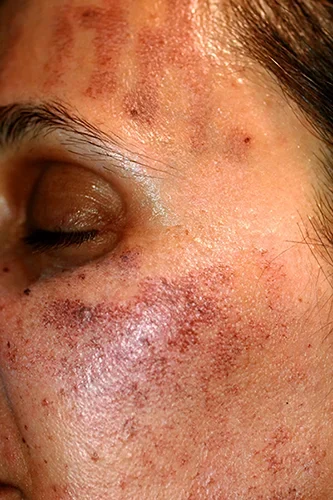
Post-inflammatory hyperpigmentation on the forehead and cheeks after laser (IPL) treatment in a woman with skin type III-IV. The rectangular spots on the forehead are marks left by the IPL crystal.
How long does PIH last?
Duration varies considerably: epidermal forms tend to resolve within 3-12 months, while dermal forms can persist for years or become permanent without proper treatment.
Who is most at risk of post‑laser hyperpigmentation: the role of skin phototype
The likelihood of developing PIH depends not only on the type of laser used, but also on the biological characteristics of the skin. The Fitzpatrick skin phototype is one of the most important factors in determining the risk of developing dark spots after a laser procedure.
Why skin phototype influences PIH risk
In Fitzpatrick phototypes III–VI, melanocytes are more numerous and more reactive. This means that when the skin is exposed to inflammation or heat (as after laser, IPL, or chemical peels), it produces more melanin, increasing the likelihood of post‑inflammatory hyperpigmentation.
Fitzpatrick skin phototypes I–VI with melanin levels, UV sensitivity, and melanoma risk
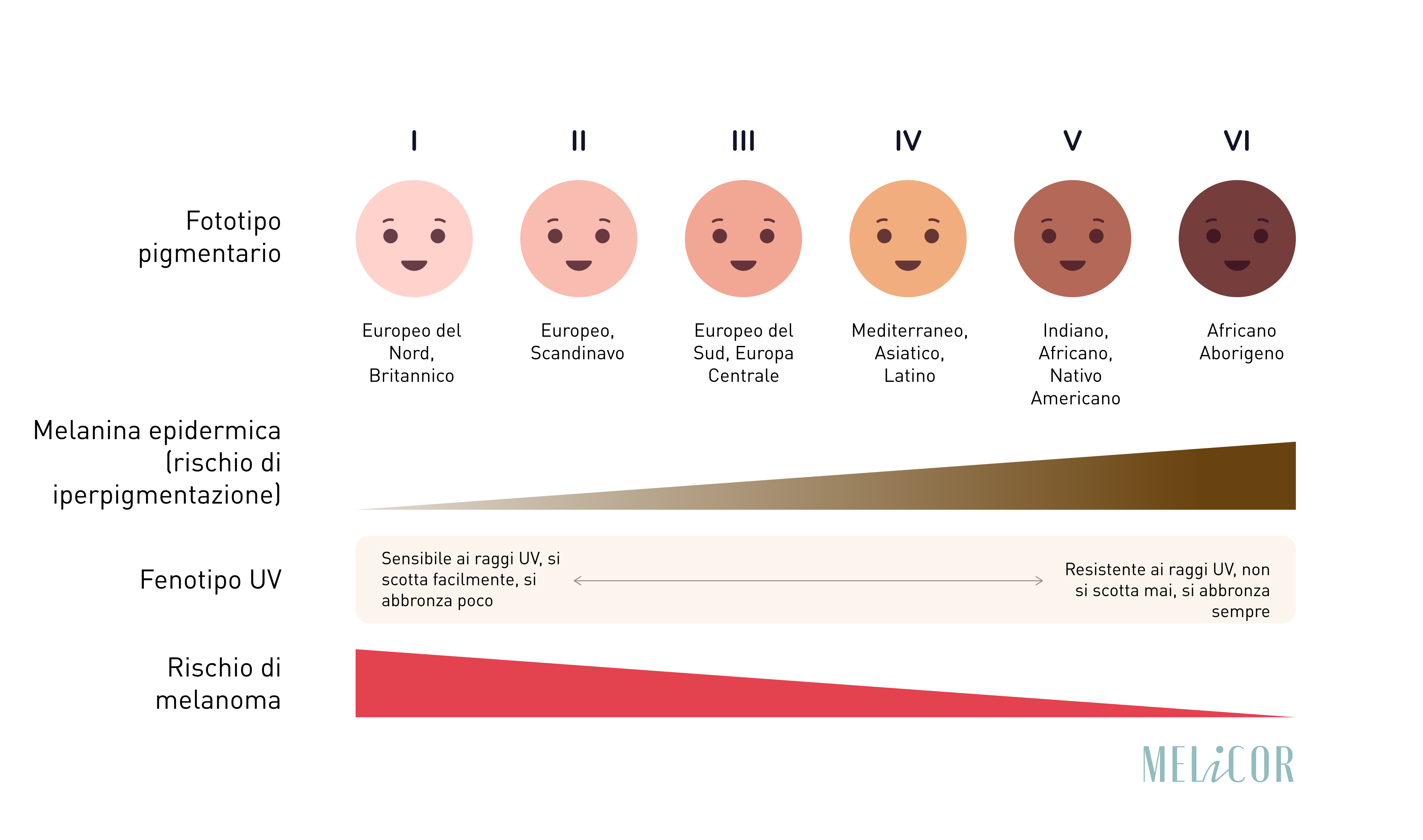
PIH risk by skin phototype
In general, the risk of post‑laser hyperpigmentation increases progressively from phototype I to phototype VI, with the highest incidence observed in phototypes IV–VI.
| Skin Type | Description | PIH Risk | Notes |
|---|---|---|---|
| I-II | Fair skin, burns easily | 3-8% | Lower risk but not absent |
| III | Medium skin, tans gradually | 12-25% | Moderate risk |
| IV | Olive skin, tans easily | 25-45% | High risk |
| V-VI | Dark or very dark skin | 45-75% | Very high risk |
Clinical note
According to studies published in Lasers in Surgery and Medicine, even procedures considered “safe” can trigger PIH in darker phototypes if adequate preventive measures are not followed.
Post‑laser hyperpigmentation risk by procedure
Not all aesthetic procedures carry the same risk of PIH.
The general principle is simple:
The more a technology generates heat and tissue coagulation, the higher the risk of post‑inflammatory hyperpigmentation.
Ablative procedures with a strong thermal effect - such as CO₂ laser and the so‑called “cold plasma” (which in reality behaves like an electrocautery device with a wide, uncontrolled coagulation zone) - are among the highest‑risk treatments for PIH. In contrast, non‑ablative technologies or devices with minimal thermal impact are generally safer, especially for Fitzpatrick phototypes III-VI.
Risk classification by procedure type
| Procedure | PIH Risk | Mechanism | Recommendations |
|---|---|---|---|
| Ablative CO₂ laser | High (40-100%) | Tissue vaporization, deep thermal damage | Skin preparation 4 weeks prior, strict sun protection |
| Ablative fractional laser | Medium-High (25-55%) | Ablation microcolumns | Conservative parameters for darker skin types |
| Q-switched Nd:YAG 532nm | Medium (20-40%) | Selective melanin targeting | Post-procedure erythema monitoring |
| Non-ablative fractional laser | Low-Medium (8-20%) | Controlled dermal heating | Safer option for skin types III-IV |
| IPL, BBL (photorejuvenation) | Medium (15-30%) | Broad-spectrum light energy | Avoid in skin types V-VI |
Picosecond Lasers | Low (5–10%) | Photoacoustic effect on the tissue with minimal thermal impact. | Post-procedure erythema monitoring |
| RF microneedling | Low (5-12%) | Dermal energy, epidermis spared | Good option for darker skin |
| Plasma (fibroblast) | Medium-High (20-50%) | Tissue sublimation, thermal micro-injuries | Only skin types I-III |
| Medium chemical peels | Low-Medium (10-25%) | Controlled exfoliation | pH-balanced acids |
| Traditional microneedling | Low (3-8%) | Mechanical microtrauma without heat | Safe for all skin types |
Factors that further increase PIH risk
- sun exposure in the weeks following the procedure
- persistent erythema lasting more than 48 hours
- Overly aggressive parameters
- Lack of skin preparation
- Personal history of hyperpigmentation
Prevention: the pre and post-procedure protocol
Preventing post‑laser hyperpigmentation is based on three essential pillars
- proper skin preparation
- inflammation control
- strict photoprotection
Following an appropriate protocol significantly reduces the risk of PIH, especially in Fitzpatrick phototypes III–VI.
Before the procedure: preparing the skin
In the 4 weeks prior to treatment, it is advisable to:
- Avoid direct sun exposure and tanning beds
- Use a broad-spectrum sunscreen daily UVB and UVA
- introduce tyrosinase‑inhibiting ingredients in high‑risk patients
- - avoid scrubs, strong acids, and irritating treatments
Una pelle stabile, non infiammata e ben protetta risponde meglio al laser e riduce la probabilità di macchie post‑infiammatorie.
After the procedure: the first 72 hours are critical
The first 72 hours determine both the outcome of the treatment and the risk of PIH.
During this phase, the skin is inflamed, vulnerable, and highly reactive to UV radiation.
It is essential to:
- Apply soothing products that reduce inflammation
- avoid any sun exposure
- avoid acids, retinoids, or exfoliants
- keep the skin barrier hydrated and intact
Why Epicalm Plus is essential in the first 72 hours
Epicalm Plus was specifically developed for the immediate post‑laser phase.
Its formula:
- inhibits tyrosinase, reducing the melanogenic cascade
- decreases pathological vascular growthi, limiting persistent erythema
- - increases keratinocyte resistance to UV by 25% , providing active protection against PIH
- supports the skin barrier during the inflammatory phase
This makes Epicalm Plus one of the most effective products for preventing PIH in the first hours and days after laser treatment.
Sun protection: the most important step
After any laser procedure, photoprotection is non‑negotiable.
You must use:
- SPF 50
- VB + UVA II + UVA I protection
- photostable filters
- reapplication every 2 hours during exposure
SPF 50 Melicor provides complete UVB and UVA I–II protection, essential for preventing PIH and photoaging.
Photoprotection must be maintained for at least 3–6 months after the procedure. To understand why UVA I–II rays are so critical in PIH prevention, see also the article on the difference between UVA and UVB rays.
Treating PIH: the modern alternative to the Kligman formula
Traditional hyperpigmentation treatment is based on the Kligman formula (hydroquinone + retinoid + corticosteroid).
Although effective, it has significant limitations:
- hydroquinone is banned in the EU for cosmetic use
- traditional retinoids often cause irritation, peeling, and rebound
- - long‑term corticosteroid use is not sustainable
For these reasons, modern dermocosmetics focus on safer, more stable, and clinically effective ingredients.
Next‑generation ingredients for treating PIH
Cosmetic research has developed safer and more effective alternatives:
- High‑bioavailability tranexamic acid
- blocks melanocyte–keratinocyte interaction
- reduces the inflammatory cascade that leads to PIH
- clinical studies: erythema reduction in 2 weeks, dark spot improvement in 4 weeks
- advanced formulations penetrate deeper and reach the target cells
- Third‑generation retinoid
- stimulates cell turnover without irritation
- - reduces wrinkles and evens skin tone
- comparative studies: 2× more effective than retinol, with 10× less redness
- Licorice Derivatives
- water‑soluble glycyrrhetinic acid provides corticosteroid‑like anti‑inflammatory action
- without the risks associated with long‑term steroid use
To discover more active ingredients useful for PIH, visit the ingredients.
Lumicor: the complete formula for post‑laser PIH
Lumicor integrates all the mechanisms needed to treat PIH effectively and safely in a single formula.
Its composition combines:
- 5% bioavailable tranexamic acid
- third‑generation retinoid
- purified curcumin
- four synergistic anti‑inflammatory extracts
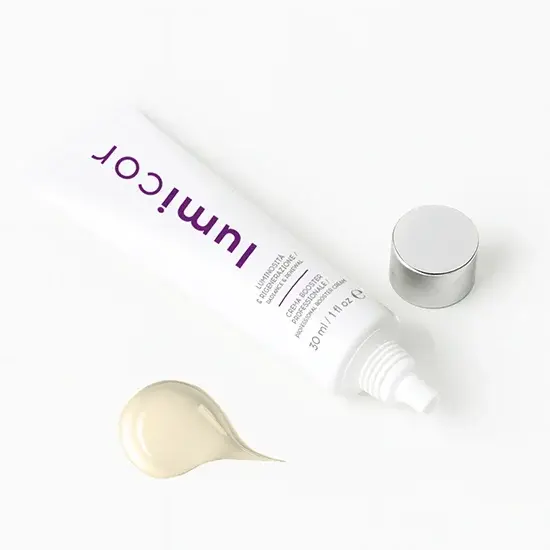
This synergy allows Lumicor to:
- reduce post‑laser erythema
- lighten hyperpigmented spots
- even out skin tone
- avoid irritation and rebound
Lumicor is particularly indicated for post‑laser PIH, where a combined action on melanin, inflammation, and cell turnover is essential.
Expected results and timeline
With a correct protocol:
- 2 weeks: visible reduction in erythema
- 4-6 weeks: attenuation of dark spots
- 8-12 weeks: improved skin tone uniformity
- 3-6 months: resolution of epidermal PIH in the majority of cases
It is important to remember that sun protection must continue throughout the treatment period and beyond, to prevent recurrence and photoaging.
Frequently Asked Questions
Is post-laser hyperpigmentation permanent?
In most cases, no.
Epidermal PIH tends to resolve spontaneously within 6-12 months, while dermal forms may require specific treatments and longer times.
With an appropriate protocol – inflammation management, rigorous photoprotection, and targeted active ingredients – even the most resistant cases show significant improvements.
Can I have laser treatments if I have dark skin?
Yes, but with specific precautions.
In dark phototypes (IV–VI) it is essential to choose technologies with low PIH risk, such as:
- RF microneedling
- non-ablative fractional lasers
- picosecond laser
It is equally important to use conservative parameters and strictly follow the post-procedure preparation and protection protocol.
How long should I wait before sun exposure after laser treatment?
It is recommended to avoid direct sun exposure for at least 4-6 weeks.
Photoprotection with SPF 50+ UVA I-II filters must be maintained for 3-6 months, even during indirect or winter exposure.
Sun protection is the most important factor in preventing PIH.
Which ingredients should I avoid during PIH treatment?
It is advisable to avoid:
- strong acids at very low pH
- aggressive mechanical exfoliants
- perfumes and denatured alcohol
- traditional retinol, if it causes irritation
Any ingredient that increases inflammation can worsen PIH or slow down results.
Further Reading
If you've noticed redness after laser hair removal, discover the specific causes and remedies. To better understand how UVA and UVB rays affect pigmentation and why sun protection is essential for preventing photoaging.
Scientific sources: Journal of Cosmetic Dermatology, Lasers in Surgery and Medicine, Dermatologic Therapy, Clinical and Experimental Dermatology